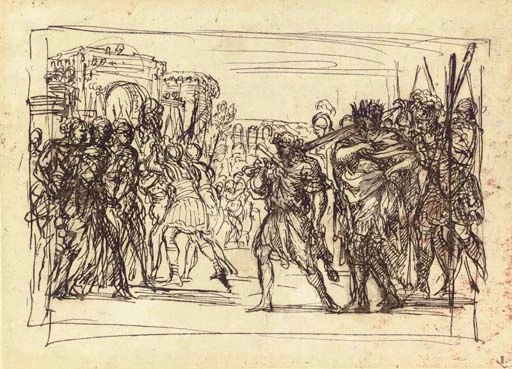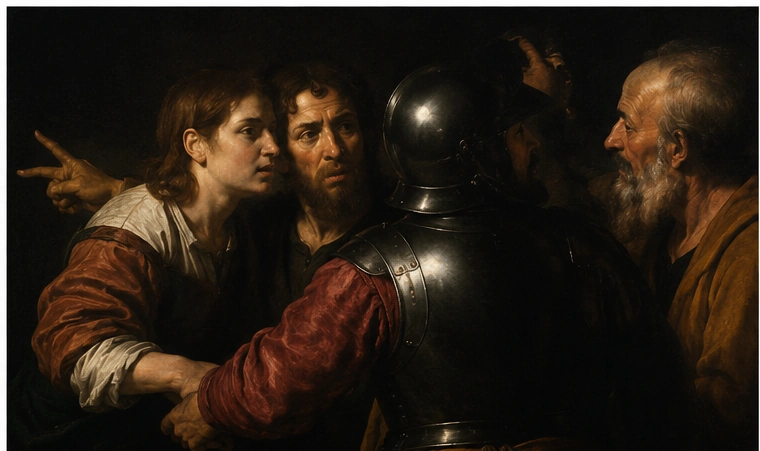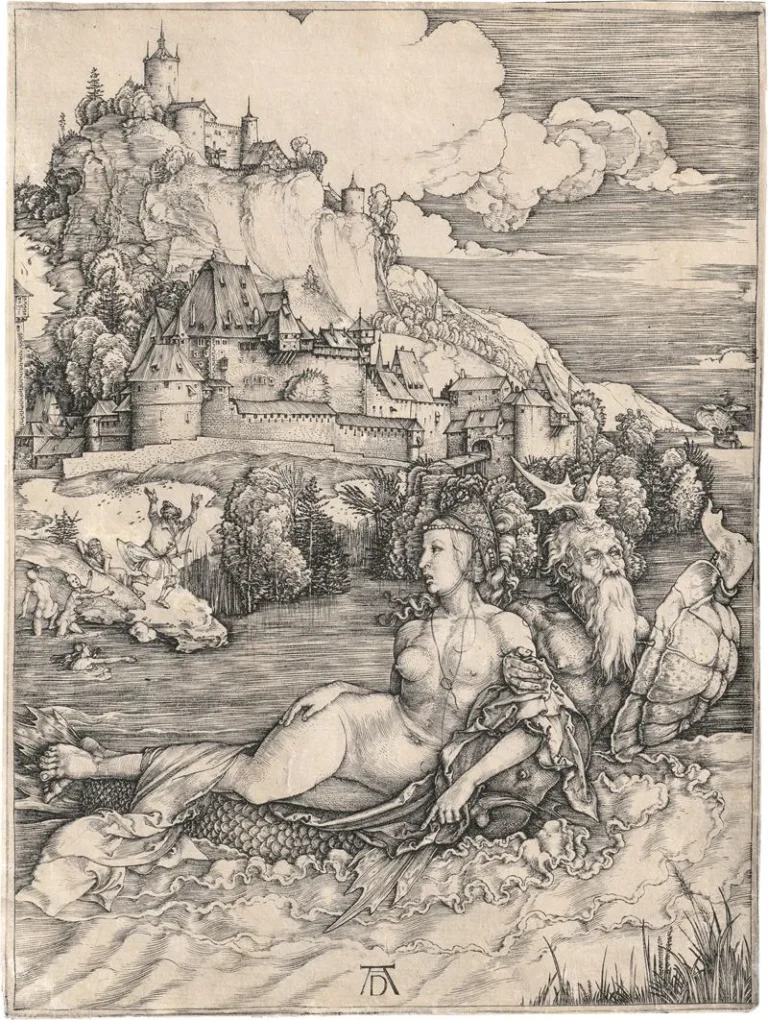

Or: Three Drawings Attributed to Antoine Watteau
A collection of three works on paper attributed to Jean-Antoine Watteau was submitted to our company for valuation and expert examination in the context of inheritance proceedings. According to the accompanying information, the previous owner had acquired these works at different times between 2015 and 2020 through private transactions and art salons in the United Kingdom.
The central issue was not Christie’s. Christie’s did not participate in the subsequent private resale of the examined works and did not authenticate them in connection with that transaction. The problem arose at another level: a later private seller presented the works as having a purported Christie’s provenance, thereby creating the impression that the sheets corresponded to historical Christie’s catalogue records. Our examination showed that this claim was unreliable.
Two of the three works proved to be materially consistent with paper from the late seventeenth to early eighteenth century — the period in which Watteau could have worked. The third work, however, had to be rejected. First, its physical dimensions did not correspond to the Christie’s catalogue description to which it had been linked. Then, visual examination in transmitted light revealed a watermark dated 1806. Since Watteau died in 1721, such a sheet cannot be an autograph work by the artist. How such an elementary chronological contradiction remained unnoticed at the time of purchase is difficult to explain. For the heirs of the collection, however, it became a deeply unsettling discovery.
The financial consequences were significant. Taking into account the acquisition history and the values assigned to the group of works, the cost of the attribution error amounted to approximately half a million pounds sterling. This case demonstrates a fundamental principle of Old Master expertise: provenance must be verified, not accepted on trust. A reference to the name of a major auction house, used by a private seller without documentary support, has no evidential value in itself.
The Three Works Submitted for Examination
The three works on paper were presented as drawings by Jean-Antoine Watteau. The accompanying information supplied by the later private seller contained references to Christie’s catalogue records. These references were treated not as established facts, but as claims requiring verification.
This distinction is essential. A historical Christie’s record has evidential value only if the object under examination can be securely matched to the specific catalogue entry. The title, subject, dimensions, medium, paper, condition, inscriptions, catalogue image, provenance and any available acquisition documents must all be checked. If the object does not correspond to the catalogue description, the claimed provenance cannot be considered confirmed.
Work No. 1 — Rejected as a Forgery
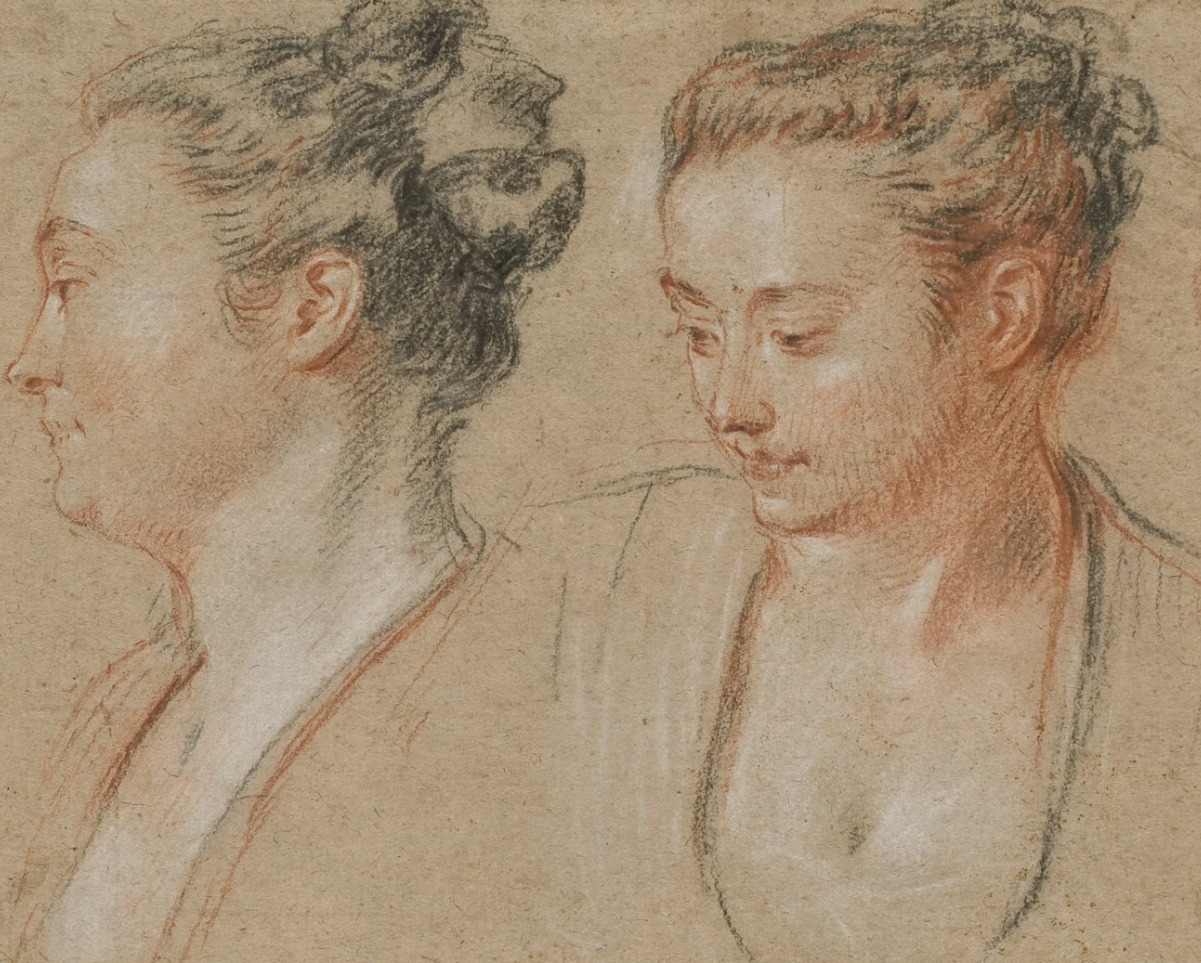
Private seller’s claimed reference: Jean-Antoine Watteau, Deux têtes de femmes / Two Heads of Women
Historical catalogue record: Christie’s, 23 June 2010
Attribution in the referenced record: Jean-Antoine Watteau, Valenciennes 1684–1721 Paris
Medium in the referenced description: red chalk, black chalk and white chalk on brown paper
Catalogue dimensions: 13 × 16.5 cm
Price realised in the referenced record: EUR 241,000
Status at private sale: presented as corresponding to the referenced Christie’s record
Expert conclusion: rejected as a work by Watteau; identified as a later imitation / forgery
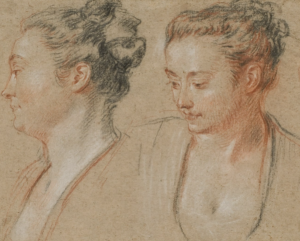
The first warning sign was a discrepancy in size. The examined sheet did not correspond to the dimensions stated in the Christie’s catalogue record to which the private seller attempted to link it. In the expertise of Old Master drawings, dimensions are among the simplest and most objective identifying features. Minor differences can sometimes be explained by trimming, mounting, framing, measurement practice or later restoration. However, if a seller claims that a particular sheet corresponds to a specific historical sale, a mismatch in dimensions must be treated as a serious risk signal.
The decisive evidence was the paper. Examination in transmitted light revealed a watermark dated 1806. This is wholly incompatible with an attribution to Watteau. The artist died in 1721; therefore, a drawing on paper bearing an 1806 watermark cannot be his autograph work.
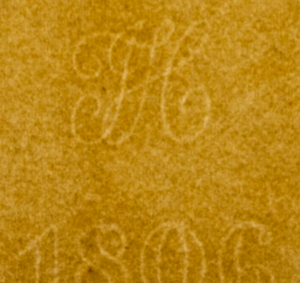
This is not a matter of subjective stylistic judgement. A dated watermark establishes a terminus post quem — the earliest possible date for the production of the paper. If the paper was produced after the artist’s death, the drawing cannot have been made by that artist. In this case, the conclusion is unambiguous: the work is not by Watteau.
Work No. 2 — Materially Consistent with the Proposed Dating
Private seller’s claimed reference: Antoine Watteau, A Woman in a Long Dress, Seated in Profile to the Left
Historical catalogue record: Christie’s, 24 January 2006
Attribution in the referenced record: Antoine Watteau, Valenciennes 1684–1721 Nogent-sur-Marne
Medium in the referenced description: red and white chalk on light brown paper
Catalogue dimensions: 8¼ × 6 in. / 211 × 152 mm
Price realised in the referenced record: USD 60,000
Status at private sale: presented as corresponding to the historical Christie’s record
Watermark: heraldic motif / coat of arms
Expert conclusion: the paper is materially consistent with the late seventeenth to early eighteenth century; no chronological contradiction was identified
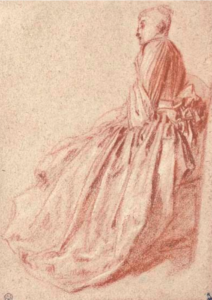
The second work corresponds to a type of sheet characteristic of Watteau’s graphic practice: a female figure executed in red and white chalk on light brown paper. Such figures could function as independent studies or as visual material later used by the artist in painted compositions.
The watermark analysis revealed no chronological contradiction. The sheet bears a heraldic motif — a coat of arms. Comparable watermarks are recorded in catalogues of laid paper from the late seventeenth and early eighteenth centuries. The paper is therefore compatible with the period in which Watteau worked.
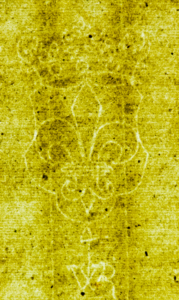
However, the conclusion must be formulated carefully. A compatible watermark does not, in itself, prove authorship. It only demonstrates that the paper could have existed in the correct period. Authorship must also be assessed through the drawing technique, provenance, comparison with catalogued sheets, condition, ownership history and documentary evidence. Unlike Work No. 1, however, this sheet contains no fatal chronological contradiction.
Work No. 3 — Materially Consistent with the Proposed Dating
Private seller’s claimed reference: Antoine Watteau, Studies of Two Girls: One Seen from Behind Looking over Her Right Shoulder, the Other Seated, Holding a Basket
Historical catalogue record: Christie’s, 8 July 2008
Attribution in the referenced record: Antoine Watteau, Valenciennes 1684–1721 Nogent-sur-Marne
Medium in the referenced description: red chalk, heightened with graphite, on light brown paper
Catalogue dimensions: 5 × 5½ in. / 128 × 139 mm
Price realised in the referenced record: GBP 63,650
Status at private sale: presented as corresponding to the historical Christie’s record
Watermark: horse motif
Expert conclusion: the paper is materially consistent with the late seventeenth to early eighteenth century; no chronological contradiction was identified
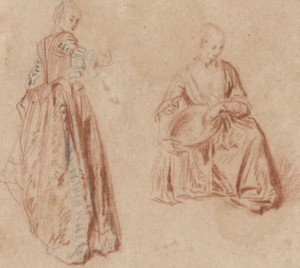
The third work also belongs to a type closely related to Watteau’s graphic practice: studies of young female figures, one seen from behind and looking over her shoulder, the other seated and holding a basket. In the historical description, the sheet was identified as a drawing in red chalk, heightened with graphite, on light brown paper.
The watermark shows a horse motif. Comparable horse watermarks are known from catalogues of paper from the late seventeenth and early eighteenth centuries. The paper therefore does not contradict the proposed dating and does not exclude a connection with Watteau’s period.
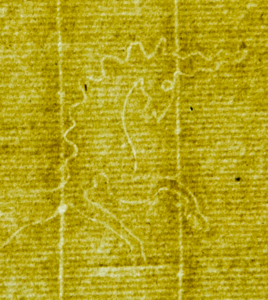
As in the case of Work No. 2, this does not automatically prove authorship. It means that the material support of the sheet does not conflict with the chronology of the artist’s life. The work remains within the category of a possible attribution, subject to further stylistic, documentary and provenance analysis.
How to Detect False Provenance and Problematic Old Master Drawings
This case provides a practical framework for collectors, heirs and art consultants working with Old Master drawings.
First, the source of provenance must be verified. A private seller’s statement that a work has “Christie’s provenance” is not evidence. What is required is the exact sale date, lot number, catalogue entry, invoice, shipping documents, labels, information on previous owners and images allowing the object to be compared with the historical lot.
Second, one must distinguish between a historical auction record and the physical object under examination. A Christie’s catalogue entry proves only that a work with a certain description was once sold. It does not prove that an object later offered by a private seller is that same sheet.
Third, dimensions must be checked. Measurements are among the simplest objective identifiers. A discrepancy does not always mean forgery, but it requires an explanation. That explanation must be documentary, not verbal.
Fourth, the paper must be examined in transmitted light. Watermarks, countermarks, chain lines and the laid structure of the paper provide essential chronological information. A watermark may not prove who made the drawing, but it can prove that the paper is too late.
Fifth, the age of the paper must be separated from the age of the drawing. Old paper could have been used later. A skilled imitator could execute a drawing on genuinely old paper. Therefore, “correct” paper is a necessary but insufficient condition.
Sixth, the work must be compared with accepted drawings by the artist. Watteau’s graphic language is subtle: his line is nervous but controlled, his modelling is delicate, and his figures often carry an inner psychological tension. A copy may reproduce the general outline but fail to convey the internal rhythm of the artist’s hand.
Seventh, inscriptions, stamps, labels and old annotations must be assessed critically. They may support provenance, but they may also be erroneous, added later or transferred from another object.
Eighth, prestige by association must be avoided. The name of a major auction house can be misused by later sellers. The key question is not whether Christie’s once sold a similar drawing, but whether the present object is demonstrably the same drawing.
The Cost of the Error
The financial consequences of this case were serious. The collection had been acquired over several years on the basis of high attributions and claimed auction provenance. The discovery that one of the three works was a later forgery dramatically changed the value of the group. The estimated cost of the error was approximately half a million pounds sterling.
For the Old Master market, this is not an exceptional situation. A small drawing can command a substantial price if it is accepted as an autograph work by a major artist. The same sheet, if reclassified as a later imitation or forgery, may lose almost all of its market value. The difference is not merely aesthetic. It is evidential.
For heirs, this has practical significance. In inheritance proceedings, valuation should not rely solely on old descriptions, dealer invoices or statements made by private sellers. A work may have been purchased in good faith, but good faith does not guarantee authenticity.