

A graphic work attributed to François Boucher, Le Miracle de Saint Louis Beltram, d’après Giovanni Battista Gaulli, was recently acquired for one of our clients and submitted for a focused attribution and material examination. The work had previously been purchased at Christie’s in 2021, and the accompanying documentation was presented in original form. Unlike cases where provenance is vague, reconstructed or merely asserted by a later seller, this work had a clear and verifiable auction history.
The purpose of our examination was not simply to rely on the authority of the auction record, but to test whether the physical object corresponded to the formal, documentary and material characteristics stated in the catalogue description. The work was checked against its recorded dimensions, technique, subject, provenance, literature reference and paper characteristics. The result was positive: the formal features matched the documented record, and transmitted-light examination revealed a watermark in the form of a crown, which supports the chronological compatibility of the paper.
This makes the drawing an interesting acquisition from both a scholarly and investment perspective. It is not a spectacular decorative sheet intended for immediate visual impact, but rather a well-documented Old Master drawing with a recognised author, transparent provenance, publication history, and material evidence consistent with the proposed dating.

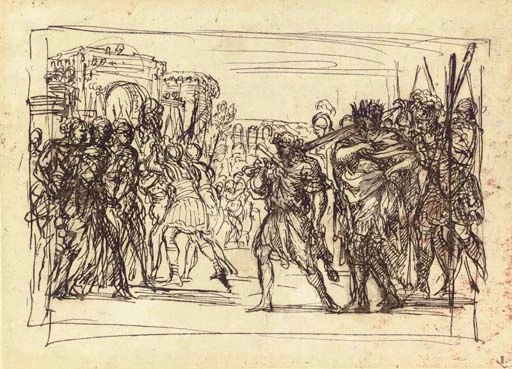
François Boucher, Le Miracle de Saint Louis Beltram, after Giovanni Battista Gaulli. Red chalk, framing lines in pen and brown ink.
François Boucher: A Brief Introduction
François Boucher was one of the central figures of French eighteenth-century art. Born in Paris in 1703 and active throughout one of the most refined periods of French Rococo culture, he became known as a painter, draughtsman, printmaker, decorator and designer. His name is closely associated with mythological scenes, pastoral subjects, elegant sensuality, decorative invention and the visual language of the rocaille.
Yet Boucher should not be reduced to the image of a purely decorative Rococo master. His artistic formation was grounded in drawing, academic training and the study of earlier masters. After winning the Paris Academy’s first prize in 1723, he worked in Paris before leaving for Italy in 1728. He returned in 1731 as a more mature artist. This Italian period is essential for understanding the present work.
The drawing examined here belongs to that formative context. It is based on a composition by Giovanni Battista Gaulli, known as Baciccio, in the church of Santa Maria sopra Minerva in Rome. Such a work shows Boucher not as the already established master of Rococo elegance, but as a young artist studying composition, movement, religious imagery and the grand Italian tradition.
This makes the drawing particularly interesting. It stands at the intersection of academic training, Italian influence and the early development of Boucher’s graphic language.
Identification of the Work
The examined drawing corresponds to the following recorded description:
Artist: François Boucher
Dates: Paris, 1703–1770
Title: Le Miracle de Saint Louis Beltram, d’après Giovanni Battista Gaulli
English title: The Miracle of Saint Louis Bertrand, after Giovanni Battista Gaulli
Medium: red chalk, framing lines in pen and brown ink
Dimensions: 34.7 × 22.4 cm / 13 5/8 × 8 3/4 in.
Auction: Christie’s
Sale date: 24 March 2021
Estimate: EUR 7,000–10,000
Price realised: EUR 7,500
Provenance: Antonio Barboza, Paris; Alfred Normand, Paris
Literature: F. Joulie and J.-F. Méjanès, François Boucher et l’art rocaille, exhibition catalogue, Paris, École des Beaux-Arts, 2003, p. 83, fig. 9.
The first stage of the analysis consisted of comparing the work with the recorded auction data. This is a basic but essential step in the examination of Old Master drawings. Even a small discrepancy in dimensions, medium or description can raise questions about whether the examined object is the same work as the one recorded in the sale.
In this case, the formal characteristics corresponded to the documented record. The size, subject, technique and provenance information were consistent with the Christie’s description. No significant contradiction was identified.
Provenance and Documentary Strength
The provenance recorded for the work includes two notable names:
Antonio Barboza (1842–1889), Paris, L. 77
Alfred Normand (1910–1993), Paris, L. 153c, verso
For works on paper, provenance is not a decorative detail. It is part of the evidential structure. Drawings can be misattributed, separated from their original context, confused with copies, or later associated with prestigious names. A documented chain of ownership, especially when supported by collector’s marks and consistent catalogue references, significantly strengthens the work’s position.
In the present case, the provenance is supported by the auction record and by the physical correspondence of the object to that record. This gives the drawing a more stable market profile than a work offered only with an oral or dealer-supplied attribution.
Literature and Art-Historical Context
The drawing is recorded in the literature:
F. Joulie and J.-F. Méjanès, François Boucher et l’art rocaille, exhibition catalogue, Paris, École des Beaux-Arts, 2003, p. 83, fig. 9.
This publication history is important. A drawing that has entered the scholarly record is generally stronger than an unpublished sheet with only a market attribution. Literature does not automatically prove authenticity, but it anchors the object within a broader art-historical discussion and makes the attribution more transparent.
The subject of the drawing also supports its early context. The work is after Giovanni Battista Gaulli, one of the major Roman Baroque painters. Boucher’s copying and study of Italian works during his stay in Rome formed part of his artistic education. The present drawing can therefore be read as both a record of study and a document of stylistic formation.
The Subject: Boucher after Gaulli
Le Miracle de Saint Louis Beltram is based on Gaulli’s painting in Santa Maria sopra Minerva in Rome. For a young French artist in Italy, such a source was not accidental. Rome offered access to the grand language of Baroque composition: dramatic movement, theatrical arrangement, expressive gesture and religious narrative.
Boucher’s drawing translates that visual source into the more intimate language of red chalk. The result is not merely a copy in the mechanical sense. It is a study of movement, figure grouping and compositional rhythm. In such sheets, one can see how an artist absorbs another master’s structure while gradually forming his own graphic temperament.
The use of red chalk is especially appropriate. Sanguine allows for fluid modelling, soft transitions and rapid notation of form. It was a central medium in academic drawing practice and particularly suited to figure studies and compositional exercises.
Material Examination and the Crown Watermark
One of the most important stages of the examination was the study of the paper in transmitted light. During this process, a watermark in the form of a crown was identified.
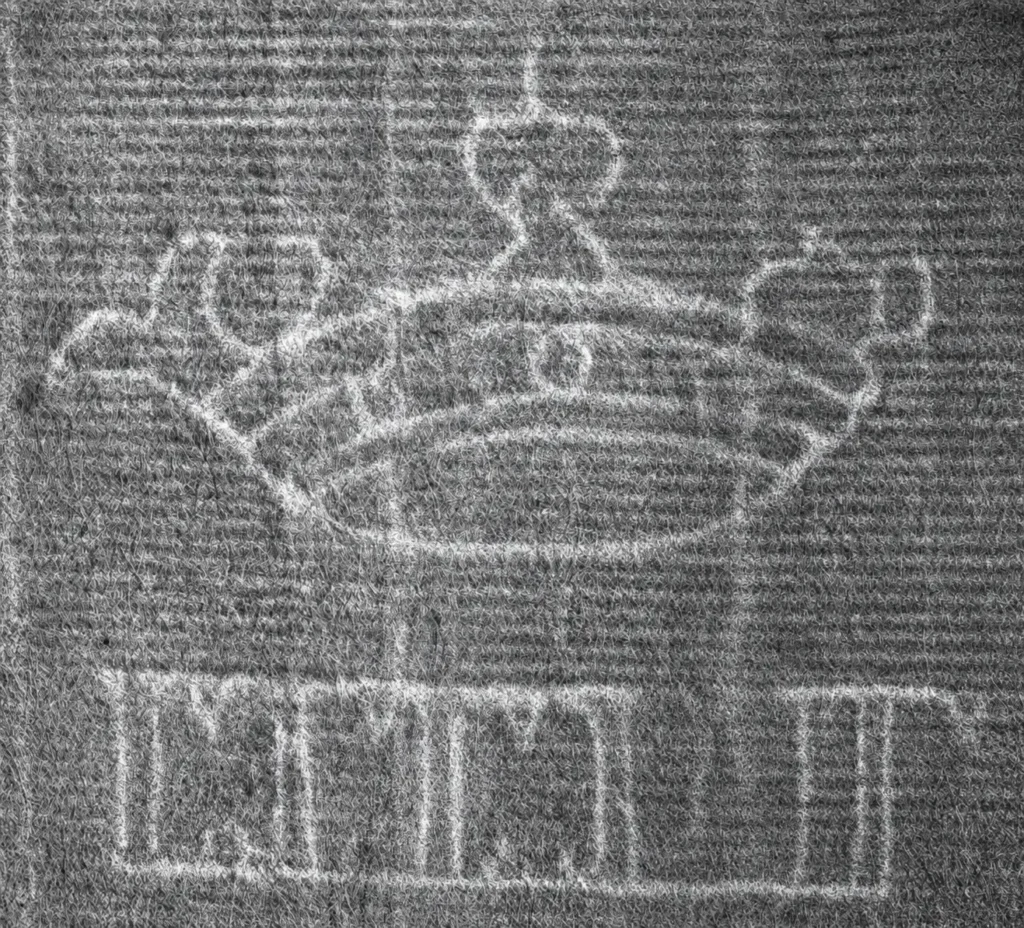
Crown watermark visible in transmitted light.
A watermark is not a signature. It does not belong to the artist. It belongs to the paper: to a mill, a papermaker, a region, or a particular production tradition. Therefore, a watermark cannot, by itself, prove that a drawing is by Boucher.
However, a watermark can be extremely important for dating and authentication. It can establish whether the paper is materially compatible with the proposed period. If the paper is too late, the attribution collapses. If the paper is historically compatible, it strengthens the overall evidential structure.
In the present case, the crown watermark did not contradict the proposed dating of the work. The paper structure and the watermark were consistent with the type of laid paper expected for a drawing associated with the early eighteenth century. This is a significant positive result.
The following material features were considered:
- laid paper structure;
- visible chain and laid lines;
- position and readability of the watermark;
- crown motif;
- condition of the paper;
- absence of obvious chronological contradiction;
- consistency between the material support and the proposed historical context.
The key point is not that the watermark proves Boucher’s authorship. It does not. The key point is that the watermark supports the plausibility of the attribution by showing that the paper is materially compatible with the period in question.
Matching the Formal Characteristics
The formal examination confirmed that the work corresponds to the recorded auction description.
Dimensions. The recorded dimensions are 34.7 × 22.4 cm. The examined object corresponds to this format. This matters because dimensions are one of the simplest objective identifiers in the study of works on paper.
Medium. The Christie’s description records red chalk with framing lines in pen and brown ink. The visual and material features of the work correspond to this description.
Subject. The drawing corresponds to the recorded subject: Le Miracle de Saint Louis Beltram, after Giovanni Battista Gaulli.
Provenance. The provenance information corresponds to the documented record, including Antonio Barboza and Alfred Normand.
Literature. The work is recorded in the 2003 exhibition catalogue François Boucher et l’art rocaille.
Paper. The crown watermark revealed in transmitted light does not create a chronological contradiction.
Taken together, these factors produce a coherent evidential picture. In problematic works, one often finds conflict between the description, the physical object, the paper, the size or the provenance. In this case, the main indicators work in the same direction.
Investment Value
From an investment perspective, this drawing is interesting for several reasons.
First, it is connected with François Boucher, one of the major names of French eighteenth-century art. Even modest works on paper by such an artist can retain long-term collecting interest when the attribution is supported.
Second, the work has a transparent auction history. It was purchased at Christie’s in 2021, and the original documentation has been preserved. For future resale or valuation, this is a meaningful advantage.
Third, the drawing has a recorded provenance and a literature reference. These factors increase market confidence and reduce the uncertainty often associated with Old Master drawings.
Fourth, the material examination did not reveal a contradiction. The crown watermark is compatible with the proposed period and supports the integrity of the work’s documentary profile.
At the same time, the investment case should be understood realistically. This is not one of Boucher’s most decorative or visually seductive Rococo compositions. It is a red chalk study after an Italian Baroque source, connected with the artist’s formative period. Its investment value lies not in spectacle, but in documentation, authorship, provenance, publication and material consistency.
In other words, this is not a speculative trophy object. It is a disciplined collecting object: historically grounded, verifiable and relatively accessible within the market for Old Master drawings.
Why This Work Matters
The importance of this drawing lies in the convergence of several types of evidence. It has a known author, a recorded auction history, documented provenance, literature, matching formal characteristics and a compatible watermark. None of these elements alone would be sufficient. Together, they create a strong attributional framework.
The work also shows a more analytical side of Boucher. It is not the polished Boucher of mythological sensuality or pastoral elegance, but the young artist studying Italian composition and translating Baroque movement into red chalk. For collectors who value the development of an artist’s hand, this can be more interesting than a purely decorative sheet.
The crown watermark adds another layer. It turns the paper from a passive support into an active piece of evidence. In the market for Old Master drawings, such details matter. They help separate works with real evidential structure from works that rely only on appearance or optimistic attribution.
Conclusion
The examination of François Boucher’s Le Miracle de Saint Louis Beltram, d’après Giovanni Battista Gaulli confirmed the consistency of the work’s formal and material characteristics with its documented record. The drawing was previously purchased at Christie’s in 2021, the original documentation was preserved, the dimensions and technique corresponded to the catalogue description, the provenance and literature were consistent, and the paper revealed a crown watermark compatible with the proposed historical period.
The principal conclusion is clear: the drawing presents no evident documentary or material contradiction to the attribution. Its strength lies in the convergence of evidence — provenance, literature, auction history, formal correspondence and paper analysis.
For a collector, this makes the work a sound and interesting acquisition within the field of French Old Master drawings. Its appeal is not based on decorative brilliance alone, but on verifiable structure. In a market where attribution errors can be costly, that kind of evidential clarity has real value.
This is precisely what makes the work compelling: it offers a new look at an Old Master not through myth or market excitement, but through careful examination, documentary discipline and material proof.