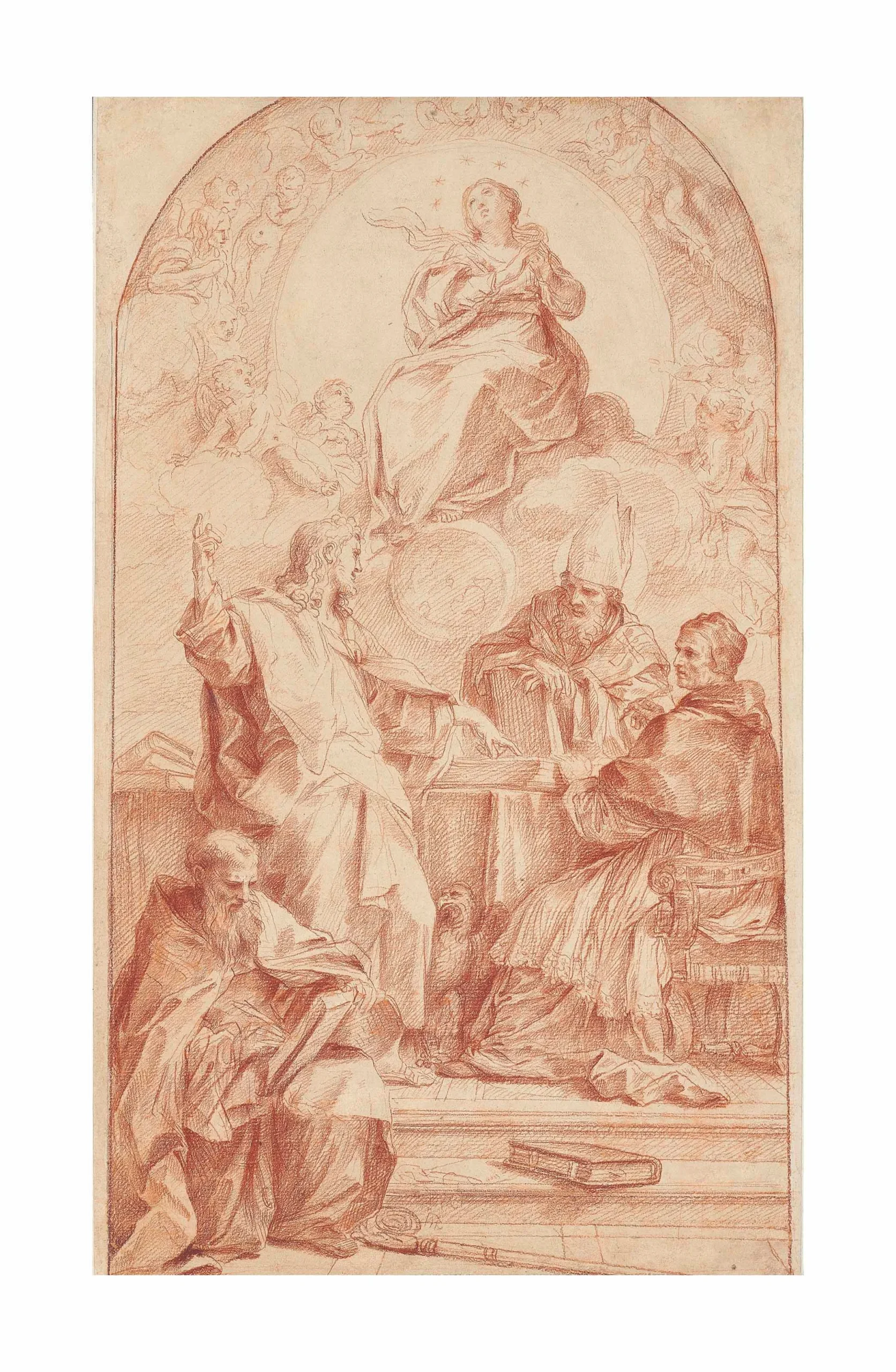

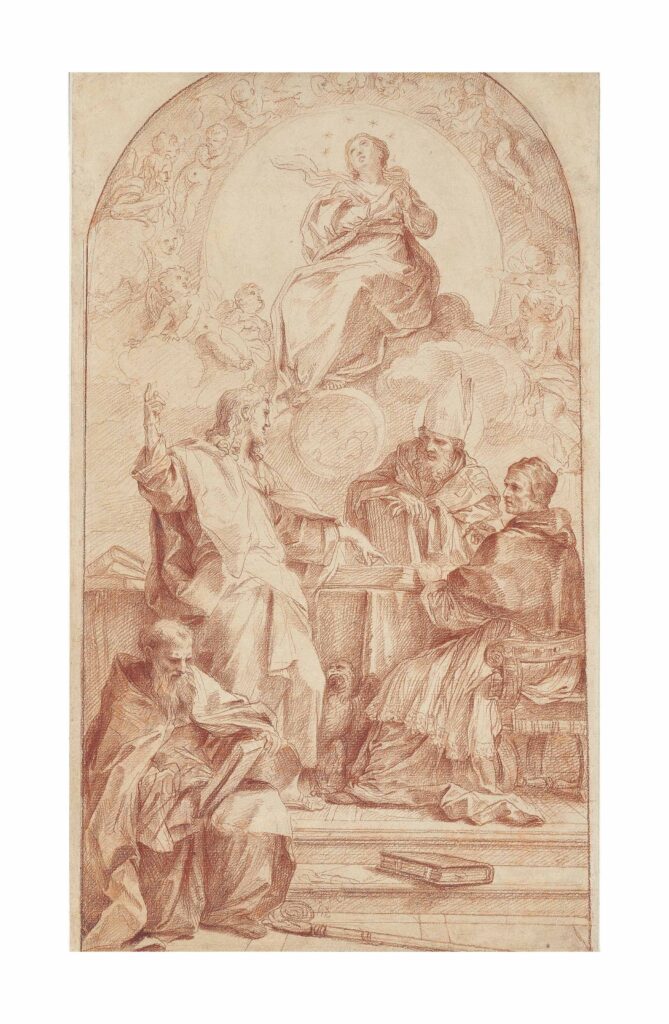
A monumental red-chalk drawing by Carlo Maratti, Saint John the Evangelist Disputing the Doctrine of the Immaculate Conception with Saints Gregory, Augustine and John Chrysostom, was recently acquired on behalf of one of our clients together with a complete set of Christie’s documentation.
The work had previously been sold at Christie’s in London on 5 July 2017. It realised GBP 209,000 against an estimate of GBP 80,000–120,000.
The existence of auction documentation was an important starting point, but it was not treated as sufficient proof by itself. The principal task of the examination was to determine whether the documents genuinely corresponded to the physical drawing presented with them and whether the sheet was the same original work illustrated, described and sold by Christie’s.
This distinction is essential in the study and acquisition of Old Master drawings. Authentic documents can become separated from the objects to which they originally belonged. They may later be associated accidentally—or deliberately—with another work of similar dimensions, medium, subject or attribution. A catalogue entry therefore has to be tested against the physical characteristics of the object.
The examined sheet was compared with the Christie’s record through its dimensions, proportions, arched format, trimmed upper edge, composition, distribution of red and black chalk, visible paper structure, provenance and relationship with the completed altarpiece in the Cybo Chapel of Santa Maria del Popolo in Rome.
The comparison produced a coherent result. The physical drawing corresponded to the work recorded by Christie’s, and no material discrepancy was identified that would suggest that the documentation belonged to another sheet. Within the scope of the comparative and material examination, both the identity and originality of the drawing were confirmed.
Examination in transmitted light also revealed an important material feature: a watermark composed of three vertically arranged circles, accompanied below by partially legible lettering ending in “…L”.
The watermark does not independently establish Maratti’s authorship. Its value is more precise: it provides evidence concerning the paper itself and allows the support to be assessed for chronological and material compatibility with the proposed seventeenth-century date.
The result is a particularly strong Old Master object: a large and highly resolved drawing connected directly with one of Maratti’s principal Roman commissions, supported by Christie’s documentation, a transparent modern provenance, a substantial body of related preparatory studies and a materially compatible handmade paper support.
Carlo Maratti, Saint John the Evangelist Disputing the Doctrine of the Immaculate Conception with Saints Gregory, Augustine and John Chrysostom. Traces of black and red chalk, within an arched top, the upper edge trimmed. 54.5 × 32.3 cm.
Carlo Maratti: A Brief Introduction
Carlo Maratti—also commonly known as Carlo Maratta—was born in Camerano in 1625 and died in Rome in 1713. Having moved to Rome at a young age, he entered the workshop of Andrea Sacchi and emerged as one of the principal heirs to the classicising tradition that extended from Raphael through the Carracci and seventeenth-century Roman painting. By the later decades of the century, Maratti had become one of the leading artists working in Rome.
His art occupies a distinctive position between Baroque monumentality and classical restraint. Whereas Pietro da Cortona represented a more expansive and theatrical current of Roman Baroque painting, Maratti pursued compositional clarity, controlled gesture, idealised figure types and carefully structured religious narrative.
This classicising tendency should not be confused with emotional or technical conservatism. Maratti’s religious paintings often combine monumental figures with highly calculated movement, refined colour and complex theological programmes. His drawings demonstrate how extensively these apparently harmonious compositions were prepared before being transferred to their final support.
The examined sheet is an exceptional example of this process. It does not merely provide a subsidiary study for a hand, head or drapery. It contains the complete structure of a major altarpiece and records the point at which Maratti’s sequence of experimentation had developed into a resolved monumental design.
Identification of the Work
The examined drawing corresponds to the following documented description:
Artist: Carlo Maratti
Dates: Camerano, 1625–1713, Rome
Title: Saint John the Evangelist Disputing the Doctrine of the Immaculate Conception with Saints Gregory, Augustine and John Chrysostom
Medium: traces of black and red chalk
Format: within an arched top; upper edge trimmed
Dimensions: 54.5 × 32.3 cm / 21½ × 12¾ in.
Auction: Christie’s, London
Sale date: 5 July 2017
Estimate: GBP 80,000–120,000
Price realised: GBP 209,000
Provenance: anonymous sale, Beaussant & Lefèvre, 10 June 2009, lot 27, as attributed to Carlo Maratti; with Jean-Luc Baroni, London, catalogue 2011, no. 11, where acquired by the subsequent owner
Function: final overall design for Maratti’s altarpiece in the Cybo Chapel, Santa Maria del Popolo, Rome
Watermark: three vertically arranged circles with partially legible lettering ending in “…L”
Christie’s described the sheet as the final design for the altarpiece that remains in the Cybo Chapel. The auction entry emphasised its unusually large dimensions, polished execution and exceptionally close relationship with the completed painting.
The Purpose of the Examination
The drawing was acquired for one of our clients with a complete set of Christie’s documents.
The examination was designed to answer two connected but distinct questions.
First, did the documents actually belong to the physical sheet presented with them?
Second, was the object an original hand-executed historical drawing corresponding to the work described and illustrated by Christie’s, rather than a reproduction, later copy or another version of the same composition?
These questions should not be conflated.
A genuine auction invoice or catalogue can establish that a work was sold, but it does not automatically establish that the object currently attached to that paperwork is the same object. Conversely, a historical drawing can be genuine as an old work on paper without necessarily being the precise drawing described in the accompanying documents.
The assessment therefore required object-to-record comparison rather than reliance on attributional authority alone.
The principal characteristics considered were:
- the dimensions and proportions of the sheet;
- the narrow monumental format;
- the arched upper boundary;
- the trimmed upper edge;
- the placement and scale of the figures;
- the relationship between red and black chalk;
- individual gestures, draperies and architectural elements;
- the paper structure visible in transmitted light;
- the recorded provenance;
- the relationship with the completed Cybo Chapel altarpiece;
- the position of the sheet within Maratti’s known preparatory sequence.
These characteristics worked in the same direction. No material inconsistency was found between the examined drawing and the Christie’s record.
Matching the Christie’s Documentation to the Drawing
Dimensions and proportions
The Christie’s catalogue records the sheet as measuring 54.5 × 32.3 cm. The examined object corresponded to this large, narrow vertical format.
Dimensions alone cannot prove identity. Paper may be trimmed, and more than one version of a composition can exist at a similar scale. Nevertheless, a substantial discrepancy would have required explanation. No such discrepancy was identified.
Arched format and trimmed edge
The upper part of the composition is defined by an arched boundary, while the upper edge of the sheet has been trimmed. Both features are specifically recorded in the Christie’s description and visible in the documented image.
These are more discriminating identifiers than subject alone. Another drawing of the same altarpiece would not necessarily share the exact format, cropping and relationship between the composition and the surviving paper edges.
Composition
The arrangement of the principal figures corresponded to the auction record.
Saint John the Evangelist stands at the left, directing attention toward the Gospel and the heavenly apparition. Saints Gregory, Augustine and John Chrysostom occupy the lower and central zones, while the enthroned Virgin appears above, surrounded by angels and cherubs.
The relative placement of the figures, architectural steps, books, drapery masses and angelic groups matched the documented work.
Medium
The Christie’s description records traces of black and red chalk. The examined sheet corresponded to this technical description.
Red chalk dominates the composition, creating both the principal contours and the modelling of bodies, garments and architectural forms. Black chalk is more restricted and does not function as an independent finished drawing. This relationship is consistent with a developed working sheet in which the artist gradually clarified a monumental design.
Correspondence with the auction image
The comparison extended beyond the general iconography.
Distinctive details—including the direction of gestures, the folds of the principal draperies, the position of the open books and the distribution of shading—corresponded to the Christie’s illustration.
The result was not merely that the examined sheet represented the same subject. It corresponded to the same individual drawing.
Confirmation of Originality
The examination also considered whether the sheet was a genuinely hand-executed drawing rather than a printed or photographic reproduction.
The chalk lines showed natural variations in pressure, thickness, direction and density. Contours were not mechanically uniform. Some were lightly indicated, while others were reinforced as the composition developed.
The shaded areas were created through accumulated individual strokes rather than reproduced tonal fields. Hatching changed direction according to the form being described: curved around bodies and draperies, more regular in architectural passages, and lighter in areas where the composition remained open.
The drawing also interacted directly with the irregular surface of the handmade paper. The chalk did not sit above the support as a printed simulation; it responded to the paper texture and fibre structure.
Transmitted-light examination revealed the laid and chain lines associated with historical handmade paper, as well as the watermark.
No evidence was identified that would indicate photographic reproduction, printed facsimile production or mechanical transfer of the entire visible image.
The conclusion was therefore twofold:
- the object is an original hand-executed work on historical laid paper;
- it is the same individual drawing described and illustrated in the Christie’s documentation.
Within the limits of the examination, the identity and originality of the work were confirmed.
The Cybo Chapel Commission
The drawing was made in preparation for Maratti’s altarpiece in the Cybo Chapel of Santa Maria del Popolo in Rome.
Cardinal Alderano Cybo commissioned the rebuilding of the chapel as a major architectural and dynastic project. Carlo Fontana began the lavish reconstruction in 1682, and Maratti participated in the interior decoration between 1684 and 1686. The chapel was unveiled on 19 May 1687.
The completed altarpiece remains in situ.
The Metropolitan Museum of Art identifies the commission as the Dispute of the Four Doctors of the Church over the Immaculate Conception and records its completion and installation in 1686. The four principal saints are John the Evangelist, Gregory the Great, Augustine and John Chrysostom.
The altarpiece was executed in oil directly on the wall rather than on a portable canvas. This technical circumstance had important consequences for Maratti’s preparatory process.
A large canvas can be revised extensively in the studio. Figures may be moved, overpainted or reconstructed before the work is transported to its destination. A monumental painting executed directly on an architectural surface allows less freedom for radical revision once work has begun.
Maratti therefore had to solve many of the principal compositional, anatomical and spatial problems beforehand through drawings. Christie’s connected the unusually large number of surviving preparatory sheets precisely with the technical demands of painting the final work on site.
The Subject: The Immaculate Conception and the Four Doctors
The drawing represents a theological discussion concerning the Immaculate Conception.
According to the doctrine, the Virgin Mary was conceived free from original sin. Although the doctrine was formally defined as Catholic dogma only in 1854, the idea had acquired broad theological and devotional support long before Maratti’s period and became an important subject in seventeenth-century art.
Maratti translates this complex theological subject into a clear visual hierarchy.
In the lower zone, the saints engage in discourse. Their books, gestures and differentiated postures communicate intellectual activity. Saint John stands prominently at the left and directs the discussion upward.
Above them appears the subject of their contemplation: the Virgin, enthroned in an illuminated celestial space and surrounded by angels and cherubs.
The composition therefore moves from text to vision, from theological argument to divine confirmation.
Saint John’s raised gesture connects the two levels. He is not simply one participant among four. His standing position and expansive movement make him the principal mediator between the scholars below and the Virgin above.
Gregory, Augustine and John Chrysostom are not arranged as an undifferentiated group. Their seated and standing positions create variations of attention, response and intellectual authority. Their books are both iconographic attributes and structural elements within the composition.
The scene is thus a disputation in subject but not a depiction of uncontrolled conflict. Maratti converts theological controversy into a carefully ordered demonstration of spiritual and institutional harmony.
The Drawing within Maratti’s Preparatory Process
A significant number of studies for the Cybo Chapel altarpiece survive.
Christie’s traced the development of the design through drawings now in the Metropolitan Museum of Art, the Royal Collection at Windsor, Düsseldorf, Chatsworth, Madrid and the Morgan Library. These sheets record different stages of compositional development and were executed in pen and ink, red chalk or combinations of media.
The Metropolitan Museum’s preliminary study demonstrates how substantially Maratti revised the arrangement. In an earlier version, Saint John stood at the far right. In later studies and the completed painting, he was moved to the left and given a more prominent rhetorical role. Saint Gregory was also repositioned and developed through several individual studies.
The examined sheet belongs near the end of this process.
Christie’s identified a smaller Morgan Library drawing as an important point of departure for the present composition. By the stage represented in the examined sheet, the principal decisions had been resolved:
- Saint John had assumed his definitive position at the left;
- his gesture connected the Gospel with the Virgin;
- Gregory and John Chrysostom responded to him;
- Augustine occupied the foreground steps;
- the heavenly and earthly zones had been integrated;
- the composition had acquired the monumental balance seen in the final altarpiece.
Christie’s noted that, apart from detailed studies of individual figures, poses and draperies, no known drawing is closer to the completed painting.
This gives the sheet a clearly defined function. It is not an exploratory sketch and not merely a workshop copy after the finished altarpiece. It represents the resolved overall design from which the remaining specific problems could be developed.
Formal Analysis
The drawing’s narrow proportions immediately create an upward movement.
The earthly disputation fills the lower half, but the figures are arranged so that their gestures and lines of sight lead toward the Virgin. The composition is therefore vertical in both format and meaning.
Saint John stands at the left, his body forming a strong diagonal. One arm is raised while the other relates to the written source of the discussion. His gesture activates the surrounding figures and opens the composition toward the celestial register.
The seated saints create a dense, stable base. Their bodies, books and layered garments give the lower zone a near-sculptural weight.
Augustine’s lower placement on the steps extends the composition toward the foreground. The books and architectural lines reinforce the transition between the viewer’s space and the theological assembly.
Above, the Virgin occupies the centre of the arched field. Her position is frontal and elevated, but the surrounding angels prevent the celestial zone from becoming static.
The arch performs several functions. It reflects the architectural destination of the composition, concentrates attention on the Virgin and compresses the angelic groups around the central apparition.
Use of red chalk
Red chalk was particularly effective for the preparatory development of figures and draperies.
Maratti varies the medium according to function:
- lighter lines establish secondary forms;
- reinforced contours clarify the principal silhouettes;
- parallel and cross-hatching produce shadow;
- curved strokes model the weight and direction of fabric;
- abbreviated marks indicate distant angels;
- denser tonal passages give the foreground saints greater physical presence.
The result is highly finished without losing the visible evidence of drawing as a process.
The sheet is not polished to the point of concealing revision. Its value lies partly in the coexistence of decision and movement: the composition is resolved, but the artist’s hand remains visible.
Maratti and Raphael
The Cybo Chapel faces the Chigi Chapel, which is closely associated with Raphael.
Christie’s interpreted Maratti’s design as a deliberate response to this setting. The pose of the Virgin recalls Raphael’s Madonna di Foligno, while the monumental saints evoke the intellectual and sculptural figures of the Disputa and the School of Athens in the Vatican Stanze.
This relationship was not an incidental matter of influence.
Maratti was one of the principal representatives of the Roman classical tradition in the later seventeenth century. By placing his altarpiece opposite a major Raphael-related monument, the architectural setting created an implicit comparison between the Renaissance master and his Baroque successor.
Maratti’s response was not to imitate Raphael mechanically. He adapted Raphael’s clarity, intellectual structure and idealised figure types to the visual and devotional requirements of late seventeenth-century Rome.
The drawing makes this dialogue particularly visible because colour and architectural splendour do not obscure the underlying structure. What remains is the organisation of bodies, gestures, intervals and lines of attention.
Provenance and Documentary Strength
The recorded modern provenance begins with an anonymous sale at Beaussant & Lefèvre on 10 June 2009, where the drawing appeared as lot 27 and was catalogued as attributed to Carlo Maratti.
It subsequently passed to Jean-Luc Baroni in London and was published as no. 11 in the dealer’s 2011 catalogue. It was acquired there by the owner who later consigned it to Christie’s.
The progression in attribution is significant.
In 2009, the drawing was cautiously described as “attributed to Carlo Maratti.” By the 2017 Christie’s sale, it was presented as a fully autograph work and identified precisely as the final design for the Cybo Chapel altarpiece.
This change should not be understood merely as a commercial escalation. The full attribution was supported by the sheet’s close correspondence with the completed painting and by its position within a substantial, institutionally documented sequence of preparatory drawings.
The modern provenance is not long, but it is transparent:
- anonymous sale, Beaussant & Lefèvre, Paris, 10 June 2009;
- Jean-Luc Baroni, London, catalogue 2011, no. 11;
- private collection;
- Christie’s, London, 5 July 2017;
- recently acquired on behalf of a private client with the complete Christie’s documentation.
For an Old Master drawing, transparent modern provenance is important. It does not substitute for attributional analysis, but it reduces uncertainty concerning the recent movement and identity of the object.
Material Examination
The paper was examined in transmitted light to assess its internal structure and identify features not visible under normal illumination.
The sheet is made on traditional laid paper. Its structure includes closely spaced laid lines and more widely separated chain lines produced by the wires of the papermaking mould.
These features are consistent with handmade European paper. Their presence alone cannot establish a precise date: traditional laid paper continued to be produced over a long period. Nevertheless, they form part of the material profile expected for an Old Master drawing.
The surface was also considered in relation to the chalk.
The drawing materials were integrated naturally with the paper structure. Variations in line density and the way the chalk responded to the irregular support were consistent with direct manual execution.
The principal additional finding was the watermark.
The Three-Circle Watermark
The watermark consists of three circles arranged vertically. Beneath the circles is a fragmentary inscription, of which the ending “…L” can be distinguished.
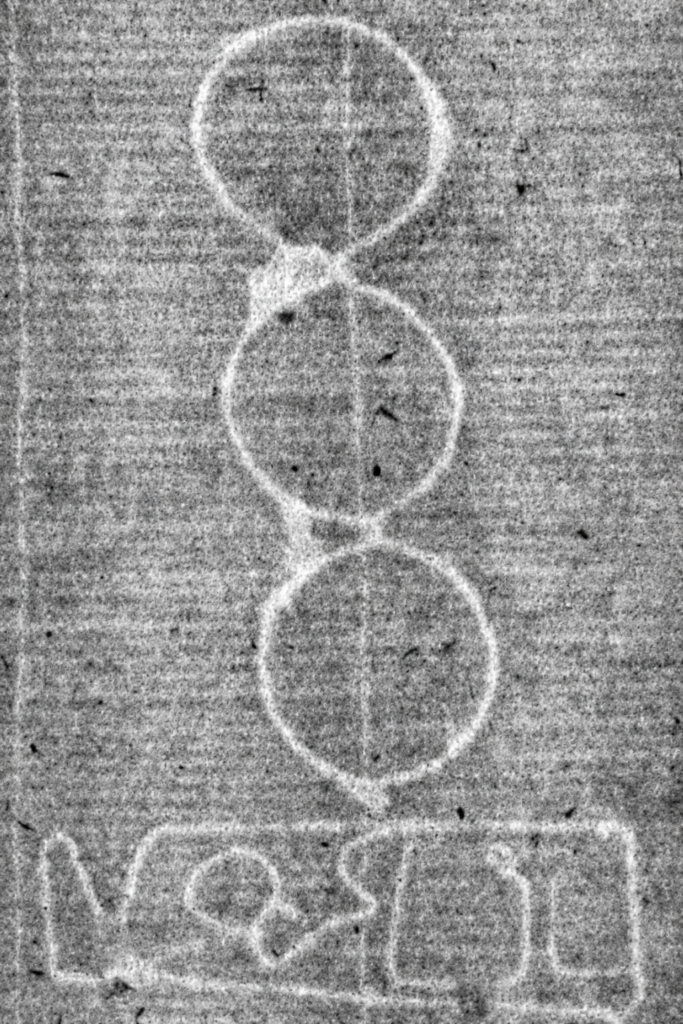
A traditional watermark was created by attaching a wire design to the papermaking mould. The wire displaced fibres while the sheet was being formed, leaving areas of reduced thickness that become visible when the paper is illuminated from behind.
The watermark therefore belongs to the manufacture of the paper, not to the subsequent act of drawing.
It is not an artist’s monogram, collector’s mark or concealed signature.
This distinction is fundamental. A watermark cannot, by itself, prove that Maratti executed the drawing. Its evidential function concerns the support:
- whether the paper is materially plausible for the proposed period;
- whether the mark belongs to a historically documented watermark family;
- whether comparable papers circulated in the relevant geographical and chronological context;
- whether the support reveals an obvious anachronism.
Three-circle motifs are particularly well documented in connection with Genoese papermaking and the international circulation of Italian paper. Scholarship on historical European paper identifies three circles—often combined with a crown, cross, letters or related symbols—among the most common Genoese watermark families.
This does not justify identifying the present paper as definitively Genoese.
The visible watermark is incomplete. No crown or cross has been securely reconstructed, and the lower inscription cannot yet be read in full. Similar motifs could be copied, modified or used by different mills over extended periods.
The mark should therefore be described rather than overinterpreted.
The scientifically defensible conclusion is:
The three-circle watermark with partially legible lettering ending in “…L” belongs to a historically documented family of European handmade-paper marks and creates no chronological contradiction with the proposed seventeenth-century dating of the drawing.
This is a positive material result, but a limited one.
What the Watermark Does—and Does Not—Prove
The watermark supports the material consistency of the drawing. It does not independently authenticate Maratti’s hand.
Its evidential value can be divided into three levels.
What can be stated confidently
The mark is integral to the paper structure rather than applied to the surface.
The paper is traditional laid paper.
The three-circle motif belongs to a historical watermark tradition.
The paper does not present an obvious chronological contradiction with the drawing’s attribution and proposed period.
What remains possible but unconfirmed
The paper may be connected with an Italian or Genoese production tradition.
The lower lettering may represent a papermaker’s name, initials, commercial designation or countermark.
The surviving sheet may preserve only part of a larger mark affected by trimming.
What cannot yet be claimed
The watermark cannot be assigned securely to a specific mill.
It cannot be dated to an exact year.
It cannot prove that the drawing was executed in Rome.
It cannot prove that Maratti personally selected the paper.
It cannot establish authorship independently of the formal and documentary evidence.
A more precise identification would require a complete transmitted-light image with scale, exact measurements of the circles, chain-line intervals, the position of the watermark within the sheet and comparison with dated examples in specialist databases and catalogues.
The Evidential Structure of the Attribution
The identification of the drawing should not be reduced to the watermark or to the Christie’s label.
Its strength lies in the convergence of several independent forms of evidence.
Formal evidence
The complete composition corresponds closely with the final Cybo Chapel altarpiece.
Developmental evidence
The sheet occupies a logical position within a documented sequence of preparatory drawings held in major institutional collections.
Functional evidence
Its scale and degree of finish are consistent with a final compositional design from which specific figure and drapery studies could be developed.
Documentary evidence
The work has a transparent modern provenance and a complete Christie’s record.
Object-to-document evidence
The dimensions, format, trimmed edge, medium and individual visual characteristics correspond to the physical sheet.
Material evidence
The work is executed manually on historical laid paper.
Watermark evidence
The three-circle watermark is compatible with a historical European papermaking context and creates no chronological contradiction.
None of these elements should be treated as absolute proof in isolation. Together, however, they create a coherent and unusually strong attributional framework.
Market and Collecting Significance
The drawing realised GBP 209,000 against an estimate of GBP 80,000–120,000.
The result was approximately 74% above the upper estimate and more than two and a half times the lower estimate.
Several factors help explain the result.
First, this is a substantial sheet by one of the leading artists of late seventeenth-century Rome.
Second, the drawing is unusually large and highly finished.
Third, it is directly connected with an important altarpiece that remains in its original architectural setting.
Fourth, its precise function is identifiable: it is not merely associated with the commission but represents the final overall design.
Fifth, the related preparatory process is extensively documented through drawings in major museums.
Sixth, the composition is visually complete and understandable as an independent work. It does not require the viewer to reconstruct a lost context from a fragmentary study of a hand or fold.
Seventh, the documented Christie’s sale provides a significant public market reference.
Nevertheless, investment analysis should remain realistic.
Old Master drawings are not liquid financial instruments. Market performance can vary substantially according to attribution, condition, provenance, publication history, subject and the number of specialist buyers active at a particular sale.
A strong 2017 result does not mechanically guarantee future appreciation.
The work’s market profile can be summarised as follows:
Artist recognition: strong within the Old Master field
Attributional structure: strong
Connection with a major commission: exceptional
Documentary strength: strong
Material compatibility: positive
Decorative and visual appeal: strong
Rarity: high
Market liquidity: limited
Price predictability: limited
Long-term collecting relevance: strong
This is therefore not best understood as a speculative object intended for rapid resale. It is a historically significant and evidentially structured acquisition suited to a serious collection of Old Master drawings.
Why This Work Matters
The drawing matters because it records a decisive stage in the creation of a monumental work.
Earlier studies show Maratti searching for the composition. Individual figure drawings show him refining anatomy, gestures and draperies. The examined sheet occupies the point between these phases: the complete architecture of the image has been resolved, but the immediacy of the drawing process remains visible.
It also documents the practical intelligence behind Baroque monumentality.
The finished altarpiece may appear inevitable when viewed in the chapel. The drawing reveals that its clarity was constructed through extensive preparation, revision and comparison.
The sheet is also evidence of Maratti’s relationship with Raphael. Facing the Chigi Chapel, his design had to establish a dialogue with one of the central traditions of Roman art. The references to Raphael are not decorative quotations but part of Maratti’s claim to continue and renew the classical language of Rome.
The material examination adds another level.
The watermark transforms the paper from a passive support into historical evidence. It connects the drawing with the production, trade and use of handmade paper. Although the mark cannot yet be assigned to a precise mill, it confirms that the support is consistent with the historical framework proposed for the work.
Finally, the examination addressed a practical collecting problem.
The drawing was acquired with authoritative documentation, but the documents were not accepted without verification. They were compared against the physical object. Their correspondence was confirmed, as was the originality of the sheet within the scope of the examination.
This is the correct evidential order: the object should support the documents, and the documents should support the object.
Conclusion
Carlo Maratti’s Saint John the Evangelist Disputing the Doctrine of the Immaculate Conception with Saints Gregory, Augustine and John Chrysostom was recently acquired on behalf of one of our clients together with a complete set of Christie’s documentation.
The primary purpose of the examination was to determine whether those documents genuinely corresponded to the physical sheet and whether the object was the same original drawing described, illustrated and sold by Christie’s.
A systematic comparison was carried out using the recorded dimensions, narrow monumental format, arched upper boundary, trimmed upper edge, composition, chalk technique, individual visual features, provenance and relationship with the Cybo Chapel altarpiece.
The physical drawing corresponded to the Christie’s record. No material discrepancy was identified that would suggest substitution or the association of the documents with another object.
The originality of the work was also confirmed within the scope of the examination. The sheet is a manually executed drawing on traditional laid paper and displays no evidence of printed, photographic or facsimile reproduction.
Its attribution is supported principally by its exceptionally close relationship with the completed Cybo Chapel altarpiece and its position within Maratti’s documented sequence of preparatory studies. Christie’s identified the sheet as the final overall design and noted that no known compositional drawing is closer to the completed work.
Examination in transmitted light revealed an additional material feature: a watermark consisting of three vertically arranged circles with partially legible lettering ending in “…L”.
The mark cannot currently be connected securely with a particular paper mill or dated to an exact year. It must not be treated as a signature or as independent proof of authorship.
Its value is chronological and material. The watermark belongs to a documented family of historical handmade-paper marks and creates no contradiction with the proposed seventeenth-century date.
The final conclusion is therefore clear: the Christie’s documents correspond to the examined drawing, the sheet is the original hand-executed work previously sold at auction, and the combined formal, documentary, developmental and material evidence supports its identification as Carlo Maratti’s final design for the Cybo Chapel altarpiece.
Its strength lies not in a single spectacular clue, but in the agreement of the entire evidential structure: the dimensions, format, technique, compositional sequence, completed painting, provenance, auction documentation, paper structure and watermark.
For a collector, this represents a major Old Master acquisition: monumental in scale, directly connected with an important Roman commission, materially consistent with its historical context and supported by substantially more than attribution or appearance alone.