

Estimated reading time: 7–8 min
Collecting 15th and 16th century prints is one of the most intellectually rewarding areas of the Old Master market. It is also one of the most technically demanding. At first glance, early prints may appear more accessible than paintings or drawings: they are often smaller, monochrome, easier to store, and available at a broader range of price points. But this accessibility can be deceptive.
A Renaissance print is not simply an image on paper. It is an object shaped by matrix, paper, state, impression quality, watermark, trimming, provenance, collector’s marks, conservation history, and bibliographic classification. Two impressions of the same subject can differ radically in value. One may be a lifetime impression with strong contrasts, full margins, correct watermark and distinguished provenance. Another may be a later, weakly printed, trimmed or restored impression with limited market depth.
The serious collector must therefore ask a sharper question: not “Is this a Dürer, Schongauer or Lucas van Leyden?” but “What exactly is this impression, and how defensible is it?”
That distinction is the foundation of collecting early prints.

Why 15th and 16th Century Prints Matter
The rise of printmaking transformed European visual culture. Before photography, before mass media, and long before digital reproduction, prints allowed images to travel. They circulated devotional models, classical compositions, ornament, portraits, political messages, scientific imagery, artistic inventions and reproductive images after paintings.
In the 15th century, woodcut and engraving emerged as powerful instruments of image distribution. Woodcuts were closely connected to book culture, devotional images and popular circulation. Engravings, often linked to goldsmith training, allowed a more precise, linear and refined form of image-making. By the 16th century, printmaking had become one of the central vehicles through which artists gained international visibility.
This is why early prints occupy a special position in collecting. They are not secondary objects. In many cases, they are the primary reason an artist’s reputation spread beyond a local or courtly audience.
Albrecht Dürer is the clearest example. His reputation across Europe was built not only through paintings, but through engravings and woodcuts that circulated widely. His prints allowed collectors, scholars and artists in different regions to encounter his inventions directly. The same is true, in different ways, for Martin Schongauer, Andrea Mantegna, Marcantonio Raimondi, Lucas van Leyden, Lucas Cranach the Elder, Hans Burgkmair, Albrecht Altdorfer and the so-called Little Masters.
For the collector, this means that 15th and 16th century prints should not be treated as cheaper substitutes for paintings. They are a separate category with their own hierarchy, scholarship and market logic.
The Main Techniques: Woodcut, Engraving and Early Etching
A basic technical distinction is essential.
Woodcut is a relief process. The image is cut into a wooden block; the raised surface receives ink and is printed onto paper. Woodcuts were relatively efficient to produce and were closely connected to book illustration, devotional sheets and broader image circulation. They can have great visual power, but the market depends heavily on impression quality, date, edition, block wear and completeness.
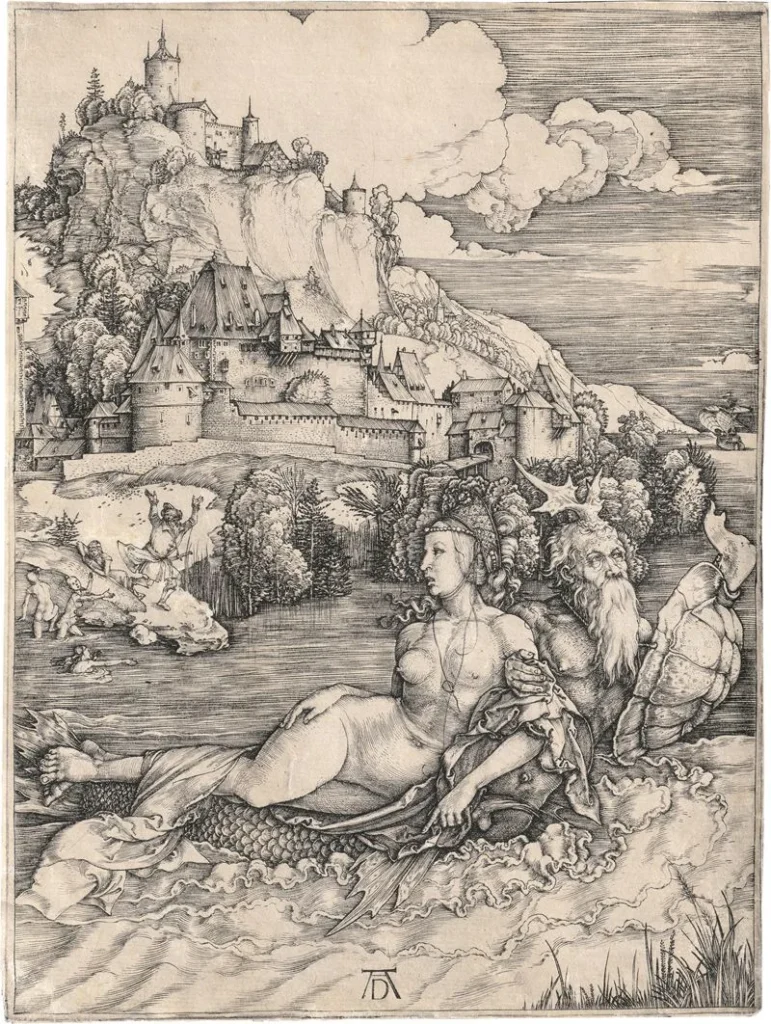
Engraving is an intaglio process. The artist or engraver cuts lines into a metal plate, usually copper. Ink is held in the incised lines and transferred under pressure to dampened paper. Engraving allowed extraordinary precision. The best early engravings show controlled line, tonal modulation, texture and complex spatial construction.
Etching appeared more fully in the early 16th century. Instead of cutting directly into the plate with a burin, the artist draws through an acid-resistant ground and acid bites the exposed lines. Etching permitted a more spontaneous, drawing-like quality, though it developed unevenly in the early period.
These technical categories matter commercially. A buyer must know whether a work is a woodcut, engraving, etching, chiaroscuro woodcut, reproductive engraving, later restrike, copy, or modern facsimile. Each has a different market status.
A vague description such as “Old Master print” is not enough. For early prints, the medium is not a detail. It is part of the identity of the work.
Key Artists for Collectors
The 15th and 16th centuries produced a complex field of printmakers, but several names dominate collector attention.
Martin Schongauer stands at the beginning of the great Northern European engraving tradition. His prints were admired across Europe and influenced later artists, including Dürer. His Temptation of Saint Anthony became one of the most celebrated early engravings because of its technical refinement and visionary demonic imagery.
Albrecht Dürer is the central figure for the market. His engravings, woodcuts and book projects define the highest level of Northern Renaissance printmaking. Works such as Adam and Eve, Knight, Death and the Devil, Melencolia I, Saint Jerome in His Study, The Apocalypse woodcuts, The Life of the Virgin and The Rhinoceros remain canonical.
Lucas van Leyden is essential for Dutch print collecting. His early mastery, narrative imagination and technical fluency make his engravings particularly important. Works such as The Milkmaid and his biblical subjects show how Northern printmaking could combine everyday observation with moral and narrative content.
Andrea Mantegna and his circle represent a different Italian tradition: sculptural form, classical antiquity, dramatic bodies and archaeological imagination. Prints associated with Mantegna and his workshop are rare and complex in attribution, but highly significant.
Marcantonio Raimondi changed the relationship between printmaking and painting. His engravings after Raphael helped create a model for reproductive print culture, where prints disseminated the inventions of major painters. This does not make them secondary in a simple sense; it makes them central to how Renaissance style circulated.
Lucas Cranach the Elder, Hans Burgkmair and Albrecht Altdorfer are also important, especially for woodcuts and the visual culture of the Reformation, imperial imagery, landscape and devotional themes.
The collector should not simply chase names. A minor or late impression by a famous artist can be less desirable than a strong, early, well-preserved impression by a less fashionable but historically important printmaker.

Major Collections and Why They Matter
The study of early prints is inseparable from major print rooms. The British Museum, the Metropolitan Museum of Art, the National Gallery of Art, the Albertina, the Rijksmuseum, the Bibliothèque nationale de France, the Louvre collections, the Kupferstichkabinett in Berlin and the Fondation Custodia are all essential reference points.
These institutions matter for several reasons.
First, they preserve benchmark impressions. When assessing a print, specialists compare line quality, plate wear, state, paper, watermark, margins and inscriptions against museum examples and catalogue raisonné entries.
Second, they shape scholarship. Exhibition catalogues, online collection records and print-room research often define how works are dated, classified and understood.
Third, they provide visual standards. A collector who has never looked closely at a strong museum impression may not understand what a weak impression lacks.
The British Museum is especially important because of the scale of its Department of Prints and Drawings and its deep holdings of major European printmakers. The Metropolitan Museum of Art and the National Gallery of Art offer open-access images that are extremely useful for comparative study. The Albertina and the Rijksmuseum are similarly important for Northern European prints.
For provenance, one name is particularly important: Frits Lugt.
Lugt’s work on collectors’ marks remains fundamental for drawings and prints. His system identifies stamped and written marks used by collectors, dealers and institutions. A small mark on the verso or lower corner of a print can transform the interpretation of its history. It may connect a sheet to a major collector, a historical sale, or an institutional deaccession. Conversely, an unidentified mark may require further research before a confident acquisition.
The Fondation Custodia in Paris, created by Frits Lugt and Jacoba Lugt-Klever, remains one of the important centres for Old Master drawings and prints. For collectors, “Lugt” is not just a name. It is a method: provenance must be read materially, not merely asserted verbally.
What Drives Value in Early Prints
The value of a 15th or 16th century print depends on multiple factors.
Artist and subject are obvious drivers, but they are not sufficient. Dürer’s great prints occupy the top tier, but even within Dürer, prices vary dramatically depending on subject, state, impression quality and condition.
Impression quality is critical. A strong early impression with rich black ink, clear lines and good tonal balance is more desirable than a pale, worn or later impression. In early printmaking, the image was pulled from a physical matrix; as plates and blocks wore down, line quality could weaken.
State matters. Many prints exist in different states, reflecting changes to the plate or block. An early state may be much rarer and more valuable than a later one. But “earlier” is not automatically better if the impression is weak or damaged.
Paper and watermark are essential. Laid paper, chain lines, watermark and paper tone can help date and authenticate an impression. A watermark consistent with known early impressions can significantly strengthen a work’s position.
Margins and trimming strongly affect value. Many early prints were trimmed, mounted into albums, folded, pasted down or cut to the borderline. Full margins are desirable, but not always expected for very early prints. The key is to understand what is normal for the artist and subject.
Condition is decisive. Losses, stains, foxing, thinning, repairs, backing, bleaching, over-cleaning, tears, folds and adhesive residues all affect value. For very rare prints, the market may tolerate condition issues, but the price must reflect them.
Provenance and collector’s marks can add confidence and sometimes value. A print with a traceable history through major collections is easier to defend than a visually similar sheet with no documentation.
Known Sales and Market Signals
The market for 15th and 16th century prints is selective rather than uniform.
At the top level, the most famous Dürer prints can reach very high prices. One of the most widely cited examples is Dürer’s Rhinoceros, where a fine impression sold at Christie’s New York in 2013 for $866,500, setting a major benchmark for the artist’s print market. This is not the normal price level for every Dürer print, but it shows what can happen when rarity, fame, condition and subject converge.
Other Dürer engravings — especially Adam and Eve, Knight, Death and the Devil, Melencolia I and Saint Jerome in His Study — remain among the most desirable Old Master prints. Their values depend heavily on state, paper, margins and condition. A compromised example may trade at a fraction of the price of a superior impression.
The market also contains more accessible but still serious material. Prints by Lucas van Leyden, Cranach, Altdorfer, Burgkmair, Beham, Pencz and other 16th-century artists can appear at more moderate levels, though rare subjects and excellent impressions can still be highly competitive.
This is why averages are misleading. Early print collecting is not a single price category. It is a hierarchy of objects.
A collector can still enter the field intelligently, but only with discipline. Buying a weak impression of a famous name simply because the name is famous is usually a poor strategy. Buying a strong, well-documented impression by a historically important artist at a rational price may be much better.
Risks for Collectors
The risks in early print collecting are real.
The first risk is misidentification. A print may be described as “by Dürer” when it is actually after Dürer, a later copy, a restrike, a facsimile or a reproductive print. The difference is not cosmetic. It can be the difference between a museum-level object and a decorative sheet.
The second risk is later impressions. Some plates and blocks were printed long after the artist’s lifetime. Later impressions can still be collectable in certain cases, but they should not be priced as lifetime or early impressions.
The third risk is condition concealment. Old paper can be skillfully restored. Repairs, thinning, bleaching and pressed folds may be difficult to see without transmitted light or professional examination. A print that looks clean in a frame may have serious hidden condition problems.
The fourth risk is trimming. A print cut inside the platemark or borderline may lose important evidence. In some cases, inscriptions, monograms or margins are partially removed.
The fifth risk is weak provenance. A seller may claim an old collection history without documentation. Collector’s marks, old mounts, invoices, sale catalogues and Lugt references should be checked rather than assumed.
The sixth risk is overpaying for common material. Some 16th-century prints are historically interesting but not especially rare. The existence of a famous artist’s name does not automatically create scarcity.
The seventh risk is export and import regulation. Early prints may fall under cultural property rules depending on country, age, value and provenance. Collectors should check export licences, VAT, customs and cultural heritage restrictions before purchase.
The eighth risk is false confidence from online images. Digital images often hide paper texture, plate tone, trimming, repairs and surface problems. Serious acquisitions should rely on condition reports, high-resolution images, raking light, verso images and, where possible, in-person inspection.
How to Build a Serious Collection
A disciplined collection of 15th and 16th century prints should be built around a clear strategy.
One approach is to collect by artist: Dürer, Schongauer, Lucas van Leyden, Cranach, Raimondi, Mantegna and others.
Another approach is to collect by theme: Passion cycles, saints, classical mythology, early landscape, ornament, portraits, scientific imagery or Reformation material.
A third approach is to collect by technique: early engraving, German woodcut, Italian reproductive engraving, chiaroscuro woodcut or early etching.
A fourth approach is to collect by provenance: prints from historic collections, identifiable collector’s marks, important sales or institutional histories.
The strongest collections often combine these approaches. They are not random accumulations of famous names. They have an argument.
Before buying, a collector should ask:
Is the attribution secure?
Is the medium correctly described?
Is this a lifetime, early or later impression?
What state is it?
Is the watermark known?
Are the margins intact?
Is the condition acceptable for the price?
Are collector’s marks identified?
Is there a catalogue raisonné reference?
Are there comparable sales?
Does the work fit the collection’s direction?
These questions are not academic. They protect the collector from expensive mistakes.
Conclusion: Early Prints Reward Knowledge
Collecting 15th and 16th century prints is not easy. That is precisely why the field remains attractive for serious collectors.
The market rewards knowledge, patience and visual discipline. A strong early print can offer historical importance, technical brilliance, rarity, provenance and intellectual depth at a level that is often still more accessible than comparable Old Master paintings or drawings.
But the field punishes superficial buying. A famous name is not enough. A beautiful image is not enough. A vague attribution is not enough.
The serious collector buys the impression, not only the subject. The paper, state, margins, watermark, collector’s marks and condition are part of the object’s value.
In this field, the smallest details can carry the largest consequences.
That is why early prints should be collected slowly, comparatively and with expert support. The best acquisitions are not merely old images. They are historically grounded objects whose quality can be defended.
Aurel Art approaches 15th and 16th century prints through this logic: not as decoration, but as evidence of one of the most important revolutions in European visual culture — the moment when images became mobile, repeatable, collectible and intellectually powerful.
Further Reading / Selected Bibliography
- David Landau and Peter Parshall, The Renaissance Print, 1470–1550. Yale University Press, 1994.
One of the most important studies of Renaissance printmaking, covering the development of woodcut, engraving, reproductive prints, workshop practice, artistic exchange and the emergence of prints as independent collecting objects. - Michael Bury, The Print in Italy, 1550–1620. British Museum Press, 2001.
A key study of Italian printmaking after the High Renaissance, especially useful for understanding reproductive engraving, publishing networks, and the circulation of images after Raphael, Michelangelo and Titian. - Arthur M. Hind, A History of Engraving and Etching from the 15th Century to the Year 1914. Dover reprint, original edition 1923.
A classic reference work on the historical development of engraving and etching, still useful for terminology, chronology and the technical evolution of early printmaking. - A. Hyatt Mayor, Prints & People: A Social History of Printed Pictures. Metropolitan Museum of Art / Princeton University Press, 1971.
A broad historical account of how printed images circulated socially, commercially and intellectually. Particularly relevant for understanding why prints became one of the first truly mobile visual media. - Richard S. Field, Fifteenth Century Woodcuts and Metalcuts. National Gallery of Art, Washington, 1965.
A focused study of early woodcuts and metalcuts, useful for the 15th-century context before the full maturity of Dürer and the great Northern Renaissance engravers. - Frits Lugt, Les Marques de collections de dessins & d’estampes. Amsterdam / The Hague, 1921 and 1956; online database by Fondation Custodia.
The essential reference for collectors’ marks on drawings and prints. Lugt’s system remains fundamental for provenance research in Old Master prints and works on paper. - Maximilian Schich, Christian Huemer, Piotr Adamczyk, Lev Manovich and Yang-Yu Liu, “Network Dimensions in the Getty Provenance Index.” 2017.
A useful methodological study showing how provenance and art-market data can be analysed through networks of collectors, dealers, sales and attributions. Relevant for understanding provenance as structured market evidence rather than anecdotal history. - Karen L. Bowen, “The Sadelers: From Printmakers to Booksellers,” Print Quarterly, Vol. 39, No. 4, 2022, pp. 379–395.
A specialised study of one of the major families of Flemish engravers and publishers, useful for understanding late 16th-century print production, publishing networks and the transition from artist-printmaker to commercial print enterprise.