

Category: Collector’s Brief
Estimated reading time: 7–8 min
Old Master prints from the sixteenth and seventeenth centuries occupy one of the most intellectually rich and structurally undervalued areas of the art market. They combine historical importance, technical sophistication, visual density, and relative accessibility in a way that few other collecting categories can offer.
For many collectors, the phrase “Old Master” immediately suggests paintings: large canvases, museum-level prices, complex attribution problems, and limited availability. Prints are different. They allow collectors to enter the world of Dürer, Rembrandt, Stradanus, Sadeler, Galle, Cort, Goltzius, and their contemporaries at price levels that are often far below comparable paintings and drawings.
This accessibility, however, should not be mistaken for simplicity. Old Master prints are highly technical objects. Their value depends not only on the artist’s name, but also on impression quality, state, edition history, paper, watermark, condition, provenance, subject, rarity, and relationship to a broader printmaking network.
A print by Jan Sadeler after another artist, a design by Stradanus engraved by the Galle workshop, an early impression by Dürer, and a late lifetime or posthumous impression by Rembrandt may all belong to the same broad field of Old Master graphics. But they do not operate in the same market position.
The central question is therefore not simply:
Is this an Old Master print?
The better question is:
What exactly is this sheet, when was it printed, how good is the impression, and where does it sit within the hierarchy of the artist, engraver, publisher, and subject?
Why Old Master Prints Matter
Old Master prints were not secondary images in the modern sense. In the sixteenth and seventeenth centuries, prints were one of the primary systems through which images, inventions, religious narratives, political messages, artistic styles, and technical knowledge circulated across Europe.
They were portable, reproducible, tradable, and collectible. They carried the designs of major artists beyond local courts and churches. They allowed compositions to travel from Antwerp to Venice, from Rome to Haarlem, from Nuremberg to Paris. They also formed a commercial ecosystem involving artists, engravers, publishers, printers, dealers, and collectors.
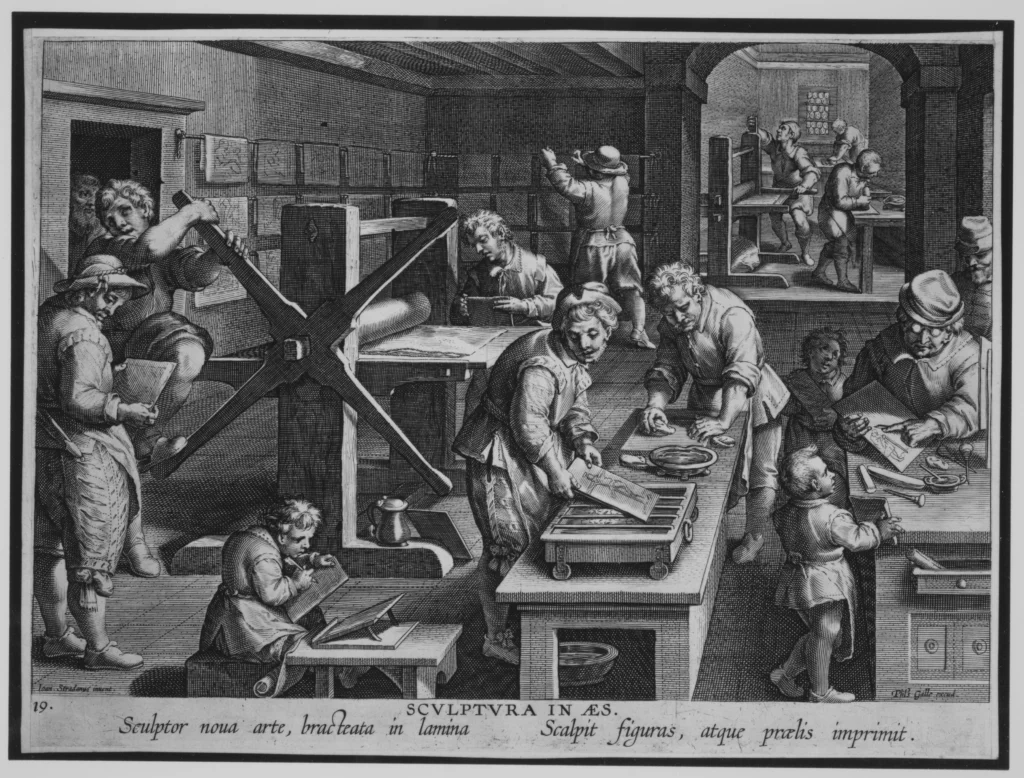
This is especially clear in the case of Stradanus. Jan van der Straet, known as Stradanus or Giovanni Stradano, was a Netherlandish artist active in Florence and connected to the Medici court. The Met notes that his Nova Reperta series was designed by Stradanus and dedicated to Luigi Alamanni; the museum also describes Stradanus as an artist who created allegorical paintings, ephemera, cartography, and Medici propaganda. Cooper Hewitt describes Nova Reperta as a print series produced by Stradanus in collaboration with Flemish printmaker Philips Galle and first published in 1591, presenting modern inventions and discoveries.
This matters for collectors because many Old Master prints are collaborative objects. A print may be designed by one artist, engraved by another, published by a third, and later issued in different states or editions. The value is therefore not determined by one name alone. It is determined by the structure of authorship.
For example, a sheet “after Stradanus” engraved by a member of the Galle circle is not the same kind of object as an autograph drawing by Stradanus. But it may still be historically important, visually compelling, and collectable. The question is not whether it is “less than” a painting. The question is what role it played in the image economy of its time.
Old Master prints reward collectors who understand systems: workshops, publishers, states, paper, iconography, and provenance.
The Market Is Accessible, But Highly Stratifie
One of the main attractions of Old Master prints is that the category remains relatively accessible compared with Old Master paintings. Christie’s explicitly frames Old Master prints as a field in which works by figures such as Dürer and Rembrandt can offer exceptional value. Sotheby’s also treats Old Master prints as a viable collecting field for new collectors, with dedicated guidance on how to begin.
But accessibility does not mean uniform affordability.
The market is sharply stratified. At the top are exceptional impressions by major artists: Dürer’s great engravings, Rembrandt’s most important etchings, rare early states, complete suites, superb lifetime impressions, sheets with distinguished provenance, and prints in outstanding condition. These can command very high prices.
Christie’s gives useful market examples: Dürer’s Melencolia I sold for £201,600 in London in July 2024; Lucas van Leyden’s The Virgin and Child with two Angels sold for $52,500 in New York in 2019; while another Dürer portrait print, Cardinal Albrecht of Brandenburg, sold for $2,520 in New York in 2023. These examples show the dramatic range within the field: artist, subject, impression quality, state, and desirability matter enormously.
Below the top tier lies a broad and attractive middle market: engravings after important compositions, works by skilled but less famous printmakers, biblical and mythological series, emblematic prints, hunting scenes, allegories, portraits, and scientific or technological subjects. This is where collectors can often find historically meaningful works at attainable levels.
The lower end includes later impressions, damaged sheets, common subjects, weak impressions, trimmed examples, anonymous prints, or works with uncertain attribution. These may still be visually interesting, but they require caution.
The market is therefore not “cheap.” It is selective. Knowledge creates the difference between a strong acquisition and a decorative mistake.
Jan Sadeler and the Printmaking Network
Jan Sadeler I is a useful example of why Old Master print collecting requires attention to networks rather than isolated names.
The British Museum identifies Jan Sadeler I as an engraver and publisher, the eldest of three brothers, originally from Antwerp; he worked in Cologne, returned often to Antwerp, served as court engraver in Munich from 1588 to 1595 with Raphael I, later moved to Venice, and died there in 1600. This biography immediately places him within several important geographies of late-sixteenth-century printmaking: Antwerp, Cologne, Munich, Venice, and the courtly/international circulation of images.
For collectors, Sadeler prints can be attractive because they sit at the intersection of technical engraving, religious imagery, court culture, and publishing history. They are often more affordable than Dürer or Rembrandt, but they still belong to a serious historical print culture.
However, the Sadeler market also requires care. Some sheets are by Jan Sadeler I; others are by Aegidius, Raphael, Justus, or members of the broader family and workshop. Some are after other artists. Some exist in later impressions. Some carry inscriptions or publication lines that need to be read closely.
A collector should not simply buy “a Sadeler.” The correct questions are:
Who designed the image?
Who engraved it?
Who published it?
Is the sheet lifetime or later?
Is it part of a series?
Is the impression strong?
Is the plate worn?
Is the paper correct?
Is the sheet trimmed?
Are inscriptions complete?
These questions may sound technical, but they directly affect value.

Impression, State, and Paper: The Real Core of Value
The most important technical question in Old Master prints is not only attribution. It is impression quality.
A print is made from a matrix: a woodblock, copper plate, or etched plate. With repeated printing, the matrix wears. Fine engraved lines become shallower. Woodblock ridges break or flatten. Etched tonalities weaken. Later impressions can appear grey, flat, or coarse compared with earlier, sharper impressions.
Christie’s explains this problem clearly: with each run through the press, the block or plate wears; later woodcut impressions may show gaps and broader lines, while later engravings can become grey and weak because the grooves hold less ink. This is why two impressions of the same image can have very different value.
The concept of state is equally important. A state refers to a version of the matrix after changes have been made. An artist, engraver, or publisher might add inscriptions, alter details, rework shadows, repair worn areas, or change the publication line. Early states are often more desirable, but not always. Some later states can also be historically important.
Paper and watermarks are another essential layer. Christie’s notes that impressions printed decades or centuries later may appear on different papers with different watermarks, and when a sheet lacks a watermark, specialists may need to rely on paper structure to estimate date.
For collectors, this means that a catalogue description matters. A serious listing should specify:
medium;
state;
paper;
watermark if known;
plate size and sheet size;
condition;
trimmed or full margins;
publisher line;
provenance;
catalogue references.
Without this information, pricing becomes speculative.
Dürer: The Benchmark for Northern Renaissance Prints
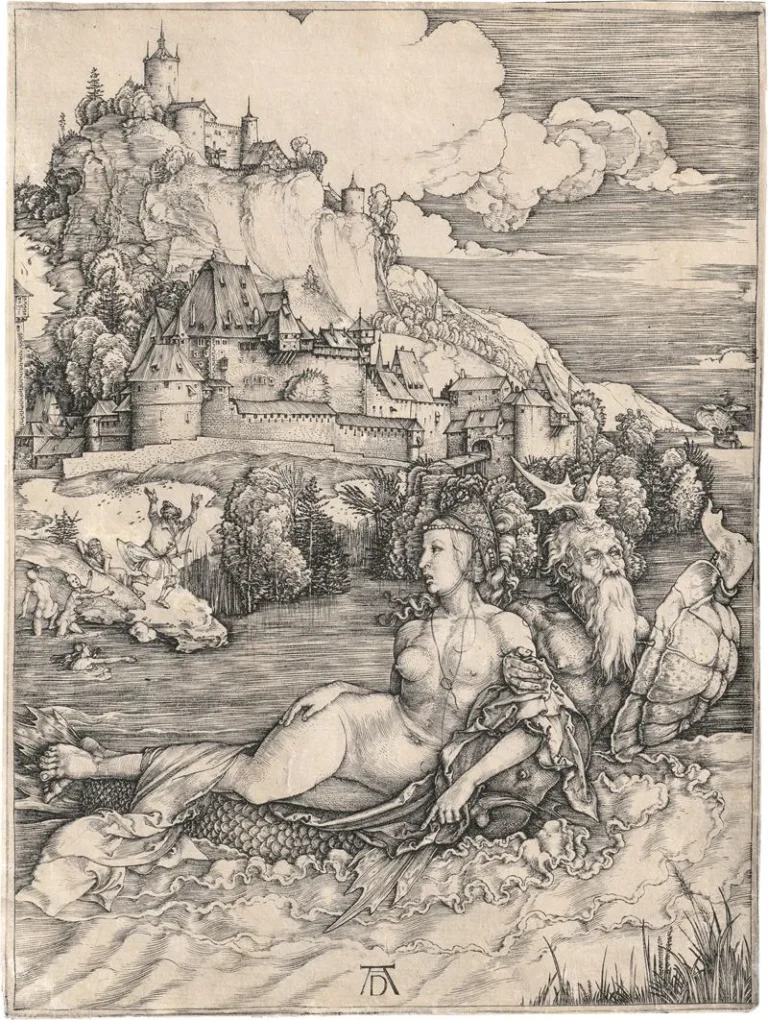
Albrecht Dürer remains one of the central benchmarks of Old Master print collecting. His engravings and woodcuts established standards of technical precision, intellectual ambition, and market desirability that still shape the field.
For collectors, Dürer is important not only because of name recognition, but because his print market is exceptionally studied. Catalogue references, states, impression quality, and condition are intensely scrutinized. This makes the market more transparent, but also more demanding.
A weak Dürer impression can still have value because of the artist’s importance, but it should not be priced as a strong impression. A fine early impression with clarity, tonal richness, strong paper, and good margins belongs to a different category.
Dürer shows the basic law of Old Master prints: the same image is not the same object if the impression is different.
This principle applies across the field.

Rembrandt and the Problem of Lifetime Impressions
If Dürer represents the intellectual and technical peak of early Northern engraving, Rembrandt represents the expressive and experimental power of seventeenth-century etching.
Rembrandt’s print market is complex because impressions can vary dramatically in quality, paper, state, and date. Some impressions are lifetime; others are posthumous. Some are printed on European paper; others on Japanese paper; some have strong burr and rich tone; others are later, weaker, or reworked.
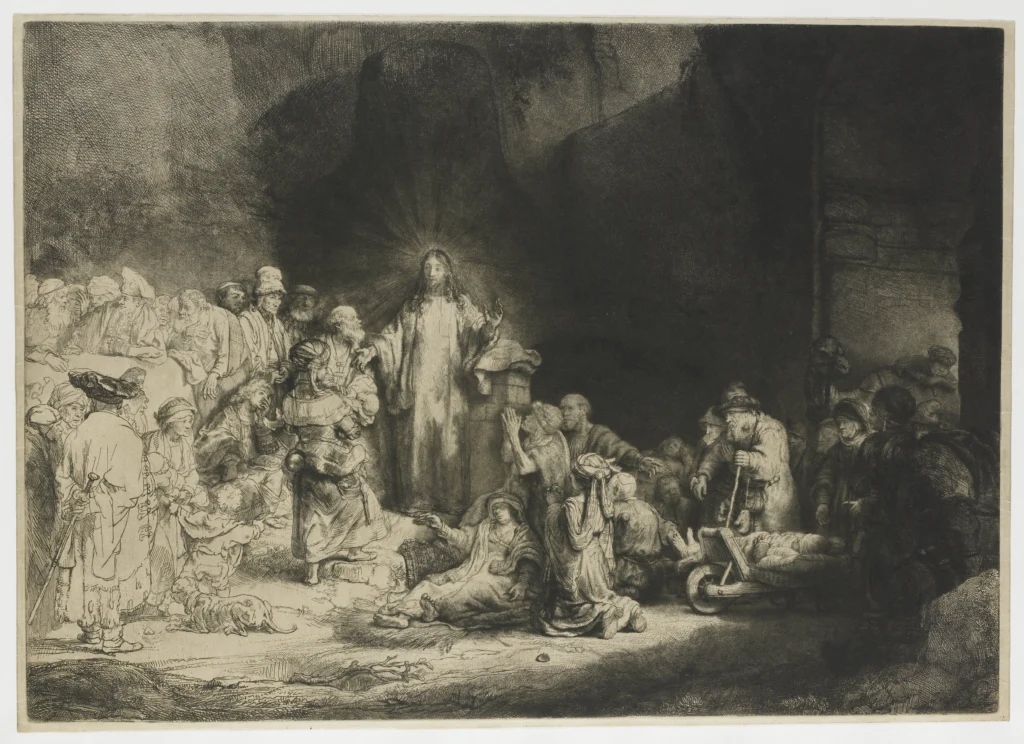
The Rijksmuseum describes The Hundred Guilder Print as an etching, drypoint, and engraving printed on Japanese paper, c. 1648, and marks the work as public domain. The Met calls the same composition one of Rembrandt’s most beautiful and complex works, noting the interplay of darks and lights and the tradition that the print had become rare by the eighteenth century.
For collectors, Rembrandt teaches a hard lesson: name alone is never enough. A Rembrandt etching can be museum-level, or it can be a much later impression with limited collector value. The range is enormous.
This is why Rembrandt prints require especially careful expert review. One must examine state, lifetime status, paper, watermark, plate wear, burr, margins, condition, and provenance. A visually similar image may represent a very different market position depending on when and how it was printed.
Availability on the Market
Old Master prints from the sixteenth and seventeenth centuries are available, but availability varies by category.
Dürer’s major engravings and woodcuts appear at auction, but the strongest impressions are scarce and expensive. Rembrandt etchings appear more frequently, but quality varies enormously. Stradanus and Galle-related works are more accessible, especially individual plates from published series. Sadeler family engravings can often be found through auction houses, specialist dealers, and institutional deaccession-related sales, but their quality and attribution must be checked carefully.
The National Gallery of Art’s own print collection gives a sense of the category’s institutional depth: the NGA states that its collection includes 75,000 prints and rare illustrated books, with comprehensive holdings of Dürer, Rembrandt, Piranesi, Blake, Cassatt, Munch, Johns, and others. This breadth explains why private collectors can still participate in the field: print culture was expansive, and many works survive outside museums.
That said, the market is not evenly liquid. A canonical Dürer or Rembrandt will have an international collector base. A specialized Stradanus technological allegory or Sadeler religious engraving may appeal to a narrower audience. Narrower demand does not make a work unimportant; it simply changes the liquidity profile.
The strongest collecting strategy is to buy works that combine at least three of the following:
recognizable artist or engraver;
important subject;
strong impression;
early or desirable state;
good condition;
complete margins or inscriptions;
clear provenance;
institutional comparability;
reasonable price.
Price Development Over the Last 30 Years
A precise 30-year price index for sixteenth- and seventeenth-century Old Master prints would require paid auction databases and careful segmentation by artist, state, impression quality, and condition. It would be irresponsible to claim a single clean “growth rate” for the whole category.
The more accurate conclusion is this: over the last three decades, the market has become more transparent, more selective, and more polarized.
Transparency increased because auction records, museum databases, online catalogues, and specialist literature became easier to access. Collectors can now compare sheets more effectively than they could in the 1990s. This benefits serious buyers, but it also makes weak material easier to identify.
Selectivity increased because collectors and specialists pay closer attention to state, paper, impression, provenance, and condition. Generic “Old Master print” descriptions are less persuasive than before.
Polarization increased because top works by Dürer, Rembrandt, and other canonical masters can command very strong prices, while common, later, damaged, or weakly described sheets remain relatively accessible.
The Christie’s examples cited above demonstrate this spread: a Dürer Melencolia I at £201,600, a Lucas van Leyden engraving at $52,500, and another Dürer portrait at $2,520. The lesson is not that “Old Master prints are expensive” or “Old Master prints are cheap.” The lesson is that the market prices specificity.
For collectors, this is an advantage. Unlike overheated contemporary markets, Old Master print valuation often rests on visible, researchable factors: state, impression, paper, subject, provenance, and catalogue references.
The category rewards knowledge more than hype.
Condition: The Silent Price Driver
Condition is one of the most important and underestimated factors.
Old Master prints are works on paper. They may have been handled, mounted, trimmed, framed, folded, washed, backed, stained, repaired, or exposed to light over centuries. Small differences can significantly affect value.
The most common condition issues include:
trimming inside or close to the platemark;
loss of margins;
paper thinning;
foxing;
staining;
creases;
tears;
old backing;
adhesive residue;
wormholes;
losses;
overcleaning;
flattened plate tone;
weak or later impressions.
Not every defect destroys value. Many old prints have some condition issues. The question is whether the defect is expected, stable, disclosed, and properly reflected in price.
A trimmed but rare print may still be desirable. A common print with serious damage may not be. A strong impression with minor age toning may be better than a weak impression in superficially clean condition.
Collectors should always request high-resolution images of the front and back, condition reports, and details of margins and paper. For more expensive purchases, specialist inspection is essential.
How to Build a Focused Collection
A collector should not begin by trying to buy “everything Old Master.” The field is too broad. A focused strategy is stronger.
One approach is to collect by school: Netherlandish, German, Italian, French, or Dutch seventeenth-century prints.
Another is to collect by technique: engraving, etching, woodcut, chiaroscuro woodcut, drypoint.
Another is to collect by theme: biblical subjects, mythology, scientific inventions, hunting, allegory, architecture, portraits, saints, emblems, theatre, or court culture.
Another is to collect by network: Stradanus and the Galle circle, the Sadeler family, Dürer and his followers, Rembrandt and his school, or Antwerp print publishers.
For a collector interested in Jan Stradanus and similar material, one strong thesis could be:
European print culture of invention, knowledge, and visual circulation, c. 1580–1650.
This would allow the collection to include Nova Reperta, Galle workshop engravings, Sadeler religious and allegorical works, scientific or technological prints, and related Netherlandish publishing culture.
That kind of collection has intellectual coherence. It is not just a group of old images; it is a study of how early modern Europe visualized knowledge.
Common Mistakes Collectors Make
The first mistake is buying only by age. A sixteenth-century print is not automatically important. Quality, state, condition, and subject matter are decisive.
The second mistake is buying only by name. “After Stradanus” or “circle of Sadeler” must be understood precisely. Designer, engraver, publisher, and date all matter.
The third mistake is ignoring margins. A print trimmed into the image or missing inscriptions may be significantly less desirable.
The fourth mistake is confusing later impressions with lifetime impressions. This is especially dangerous with Rembrandt.
The fifth mistake is underestimating paper. Watermarks, laid lines, chain lines, and paper structure can help determine date and authenticity.
The sixth mistake is buying without provenance or catalogue references. Old Master prints can carry collector marks, inscriptions, and stamps that strengthen the object’s history. Christie’s notes that from the seventeenth century onward, print collectors and dealers often marked their holdings with inscriptions and stamps, usually on the reverse.
The seventh mistake is expecting fast resale. Old Master prints can be liquid at the right level, but the market is specialist. A strong sheet may need the right auction, dealer, or collector.
Conclusion: Old Master Prints Reward Connoisseurship
Collecting sixteenth- and seventeenth-century European prints is one of the most intellectually rewarding ways to enter the Old Master field. It offers access to major names, complex artistic networks, and historically important imagery at levels that remain, in many cases, more approachable than paintings or drawings.
But the category is not simple. It requires connoisseurship.
A serious collector must learn to read impressions, states, paper, inscriptions, condition, and provenance. They must distinguish designer from engraver, publisher from later issuer, lifetime impression from posthumous printing, and strong sheet from weak example.
This is especially true for figures such as Stradanus and Jan Sadeler. Their works belong to a rich ecosystem of European image production, but their value depends on precise identification and quality assessment.
The market over the last 30 years has not rewarded everything equally. It has rewarded clarity, quality, rarity, condition, and scholarship. Generic material remains accessible. Exceptional material has become more competitive.
That is exactly why the field remains attractive.
In contemporary art, collectors often compete over visibility. In Old Master prints, they compete over knowledge.
For disciplined collectors, that is an advantage.
Selected Sources
- The Metropolitan Museum of Art — Jan van der Straet / Stradanus, Nova Reperta and Old Master print records.
- Cooper Hewitt, Smithsonian Design Museum — Stradanus’s Nova Reperta and the Nature of Novelty.
- British Museum — biography of Jan Sadeler I.
- Christie’s — A guide to Old Master prints.
- Sotheby’s — How to Start a Collection of Old Master Prints.
- National Gallery of Art — Prints collection overview.
- Rijksmuseum — Rembrandt, The Hundred Guilder Print.
- The Metropolitan Museum of Art — Albrecht Dürer, Melencolia I.