
Category: Collector’s Brief
Estimated reading time: 7–8 min
Collecting art is often described as an emotional process. A collector encounters a work, feels a connection, and decides to acquire it. This emotional dimension is real and should not be dismissed. Without personal conviction, a collection can become sterile: technically correct, but visually and intellectually weak.
Yet serious collecting cannot rely on emotion alone.
A strong collection is not simply a group of works purchased over time. It is a structured body of objects connected by taste, research, timing, budget discipline, documentation, and long-term vision. The most successful collections usually have a recognizable internal logic. They may focus on a period, a region, a medium, a conceptual theme, a group of artists, a cultural question, or a specific collecting philosophy.
The difference between buying art and building a collection is strategy.
A buyer reacts.
A collector develops.
This distinction is important because the art market is persuasive. Galleries, fairs, auctions, artists, advisors, social media, and cultural events all produce signals. Some are valuable. Others are noise. Without a collecting strategy, it becomes easy to overpay, follow trends, accumulate unrelated works, or mistake availability for opportunity.
The purpose of a collector’s strategy is not to remove pleasure from the process. It is to make pleasure more intelligent.

From Acquisition to Collection
The first step in serious collecting is understanding the difference between acquisition and collection.
An acquisition is a single transaction. It can be excellent, poor, rational, impulsive, expensive, or opportunistic. A collection, however, is a system. Each work should have some relationship to the others, even if that relationship is not obvious at first glance.
This does not mean that every collection must be narrow. Some of the most interesting collections are broad and eclectic. But even eclectic collections need coherence. The coherence may come from the collector’s eye, from a recurring theme, from a cultural geography, from material sensitivity, from a philosophical question, or from a consistent approach to artists at certain stages of development.
A collection without coherence often becomes visually and financially inefficient. It may include good individual works, but they do not strengthen each other. They do not form a narrative. They do not reveal the collector’s position. In such cases, the collection is more like an inventory.
This matters because collections are read as a whole. When advisors, curators, galleries, institutions, or future buyers evaluate a collection, they look not only at individual works but at the intelligence of selection. A collection with a clear point of view can become more significant than the sum of its parts.
A serious collector should therefore ask early:
What kind of collection am I building?
What do I want the collection to say?
Which artists, periods, regions, or themes matter to me?
What level of risk am I willing to take?
Am I collecting for personal meaning, cultural relevance, financial resilience, or a combination of these?
Without such questions, collecting becomes reactive. With them, it becomes intentional.
Defining a Collecting Thesis
A collecting thesis is not a rigid rule. It is a guiding logic.
It helps the collector decide what belongs in the collection and what does not. It also protects the collector from buying every attractive object that appears. This is important because the art market constantly offers temptation. There will always be a beautiful work, a persuasive gallery presentation, a limited opportunity, a fair booth, an auction lot, or a private offer that seems urgent.
A collecting thesis slows the decision down.
For example, one collector may focus on emerging artists from a specific region. Another may build around women artists working with abstraction after 1970. Another may collect contemporary photography dealing with urban memory. Another may focus on works on paper by established artists. Another may build a cross-generational collection around material experimentation.
Each thesis creates a different acquisition logic. It defines what kind of research is needed, what price levels are reasonable, what risks are acceptable, and what gaps should be filled over time.
The thesis does not need to be final at the beginning. In fact, many collectors discover their true direction gradually. Early acquisitions often reveal patterns: recurring colors, subjects, media, emotional responses, or intellectual interests. The advisor’s task is to identify these patterns and help the collector turn instinct into structure.
A good collecting thesis should be specific enough to guide decisions, but flexible enough to evolve.
Too broad: “I collect contemporary art.”
More useful: “I collect contemporary artists whose work explores memory, architecture, and material traces.”
Even stronger: “I focus on artists from Eastern Europe and Central Asia working with memory, archive, and post-industrial landscapes.”
The more precise the thesis, the easier it becomes to build depth.

Budget Discipline and Acquisition Rhythm
Budget discipline is one of the least romantic but most important parts of collecting.
A collector without a budget framework is vulnerable to emotional overpayment. This does not mean that every purchase must be financially conservative. Some works justify stretching the budget. But exceptions should be intentional, not habitual.
A practical collecting budget should include more than the purchase price. It should also account for:
buyer’s premium;
VAT or import costs;
shipping;
insurance;
framing;
installation;
storage;
condition reports;
conservation;
advisor fees;
future resale costs.
Many new collectors underestimate these secondary expenses. As a result, they may spend the full budget on acquisition and later discover that proper care, logistics, and documentation require additional resources.
Acquisition rhythm also matters. Some collectors buy too quickly in the beginning. They want to build a collection immediately, especially after visiting fairs or discovering a new area of interest. This can lead to uneven quality. A better approach is to combine active research with selective buying.
A collection does not need to grow fast. It needs to grow intelligently.
In many cases, one strong acquisition per year is better than five weak ones. A smaller collection with discipline can be more powerful than a larger collection built through impulse.
Collectors should also understand the difference between opportunity and pressure. A real opportunity is a work that fits the collecting thesis, has strong quality, is properly documented, and is priced defensibly. Pressure is often created by artificial urgency: “This is the last work available,” “Another collector is interested,” “The price will rise next month,” or “You should decide today.”
Sometimes such statements are true. Often, they are sales tactics.
Budget discipline helps the collector remain calm.
Quality Before Quantity
One of the most common early mistakes is building volume instead of quality.
The logic is understandable. A collector wants to see the collection grow, fill walls, explore multiple artists, and participate in the market. But quantity can become a trap. A large number of average works creates storage, insurance, documentation, and resale problems. It also dilutes the collection’s identity.
Quality is not always the same as price. A strong work by a lesser-known artist can be more meaningful than a weak work by a famous name. A small work on paper can be more important than a large decorative canvas. A modestly priced photograph can be more conceptually precise than an expensive but generic painting.
The key is to evaluate each work within its own context.
Is this a strong example of the artist’s practice?
Does it belong to a meaningful period or body of work?
Is it visually and conceptually resolved?
Does it add something to the collection?
Would it still be compelling without the artist’s name attached?
Would it be difficult to replace?
The last question is especially useful. If a work is easily replaceable, its strategic importance may be limited. If it is rare, unusually strong, or closely aligned with the collection’s thesis, it deserves more attention.
Collectors should resist the temptation to buy secondary works only because the primary works are inaccessible. There is nothing wrong with accessible acquisitions, but they must be understood honestly. A minor work by a major artist should not be confused with a major work.
A strong collection is built by choosing carefully, not by accumulating constantly.
Research as Part of Collecting
Research is not separate from collecting. It is part of collecting.
The more a collector understands an artist, the better they can evaluate quality, pricing, and long-term relevance. Research helps distinguish between a visually attractive work and an important work. It also helps the collector avoid superficial narratives.
Research may include:
artist biographies;
exhibition histories;
gallery representation;
museum acquisitions;
catalogues and monographs;
auction records;
critical essays;
studio visits;
conversations with curators, galleries, and advisors;
condition and provenance documentation.
For emerging artists, research often focuses on trajectory: education, exhibitions, residencies, curatorial attention, gallery support, and collector base. For established artists, research focuses more on hierarchy: periods, series, market history, provenance, and institutional placement.
Research also improves confidence. A collector who understands why they are buying is less vulnerable to fashion. They can explain the acquisition not only emotionally, but intellectually.
This does not mean that every collector must become an art historian. But a serious collector should develop enough knowledge to ask better questions.
The art market often rewards those who know what they are looking at before everyone else does.
Documentation and Collection Management
A collection is not only made of artworks. It is also made of records.
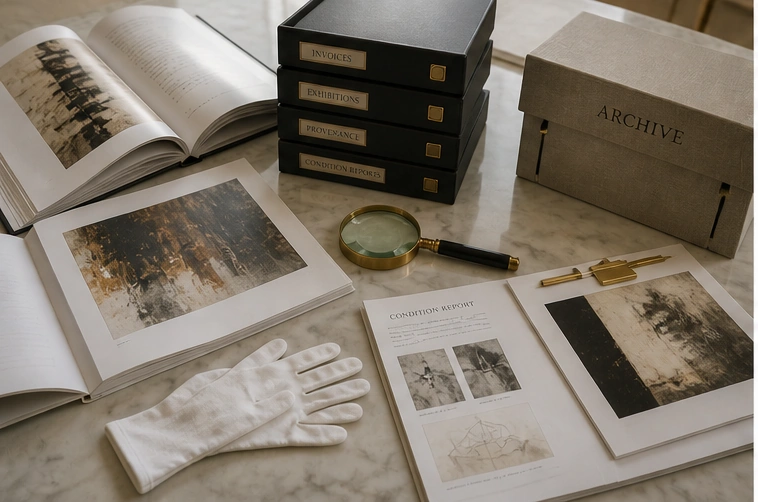
Documentation may seem administrative, but it directly affects the future value, usability, and security of the collection. A work without proper documentation can become difficult to insure, lend, sell, or authenticate. Even when the artwork itself is strong, weak records create uncertainty.
Every collection should maintain a structured archive including:
purchase invoices;
certificates of authenticity;
provenance documents;
condition reports;
photographs;
framing details;
insurance valuations;
shipping records;
installation instructions;
conservation history;
correspondence with galleries or artists.
For digital management, even a simple database is better than scattered files. The record should include artist name, title, date, medium, dimensions, acquisition source, price, location, documentation status, and images.
This becomes increasingly important as the collection grows. What feels manageable at ten works becomes chaotic at fifty. What feels obvious today may be forgotten in five years.
Good collection management also protects the collector legally and financially. It helps clarify ownership, supports insurance claims, simplifies estate planning, and improves the collection’s professional credibility.
For collectors who may one day sell, donate, lend, or transfer works, documentation is not optional. It is part of the collection’s infrastructure.
Risk: The Part Collectors Prefer to Ignore
Every acquisition carries risk.
Some risks are financial: overpayment, weak resale market, low liquidity, price correction.
Some are legal: unclear ownership, authenticity disputes, sanctions, import/export restrictions.
Some are physical: damage, poor storage, conservation issues.
Some are reputational: controversial provenance, artist scandal, unstable market narratives.
Some are strategic: buying outside the collection’s thesis, following trends, or accumulating weak works.
Collectors often prefer to focus on the positive story. This is understandable, but incomplete. A professional approach requires evaluating what could go wrong.
Risk does not mean the collector should avoid acquisition. It means the collector should price uncertainty correctly.
For example, an emerging artist may offer high upside but lower liquidity. A historical work may offer stronger cultural validation but require more complex provenance research. A work bought at auction may provide public price transparency but also create a visible resale benchmark. A private sale may offer discretion but less public comparability.
Different works carry different risk profiles.
A collector’s strategy should define how much risk is acceptable and where that risk belongs. Some collectors prefer stability and established names. Others accept emerging-market risk in exchange for earlier access and stronger personal involvement. Neither approach is universally better. The problem arises when collectors take risk without understanding it.
Risk should be chosen, not discovered after purchase.
Living With the Collection
A serious collection should not exist only as a financial asset or storage inventory. Art is meant to be lived with, studied, shared, and reconsidered over time.
Living with art changes the collector’s understanding. Some works become more powerful with time. Others lose their energy. Some reveal depth slowly. Others remain impressive but emotionally distant. This experience is part of the collecting process.
Collectors should periodically review the collection:
Which works still feel essential?
Which works no longer fit the direction?
Where are the gaps?
Which artists deserve deeper commitment?
Which works require better documentation or conservation?
Should some pieces be sold, donated, or reframed?
A collection is not static. It can evolve. Deaccessioning — selling or removing works from the collection — should not be seen as failure. It can be part of refinement. The strongest collections often become stronger because collectors learn to edit.
Taste develops. Knowledge develops. Strategy develops.
The collection should develop with them.

Conclusion: A Collection Is a Long-Term Argument
A collection is a long-term argument.
It reveals what the collector values, how they see the world, what risks they accept, what histories they engage with, and what cultural questions they choose to support. It is built not only through purchases, but through attention, patience, research, and discipline.
The strongest collections are rarely accidental. They are shaped by both intuition and structure. They allow emotion, but they do not surrender to impulse. They respond to beauty, but they also ask whether the work is important, defensible, documented, and coherent within the collection.
For new collectors, the essential task is not to buy quickly. It is to learn how to see.
For experienced collectors, the task is not simply to acquire more. It is to refine, deepen, and protect the collection’s logic.
A good collection does not need to be large. It needs to be intentional.
In the art market, anyone can buy an artwork. Building a collection requires something more demanding: judgment.