
Category: Collector’s Brief
Estimated reading time: 7–8 min
Salvador Dalí’s graphic market is one of the most accessible and one of the most dangerous areas of twentieth-century collecting. It attracts new collectors because the artist’s name is globally recognizable, the imagery is immediately memorable, and works described as lithographs, etchings, woodcuts, or mixed-media prints appear constantly at auctions, galleries, online platforms, and estate sales.
At first glance, this seems like an ideal entry point into Surrealism. Paintings by Dalí are beyond the reach of most private collectors, while graphic works can be found at comparatively approachable price levels. A collector can encounter Dante illustrations, biblical subjects, mythological cycles, dreamlike figures, distorted bodies, watches, horses, angels, butterflies, and optical illusions — all carrying the visual language associated with Dalí.
But this accessibility is exactly what makes the market complicated.
Dalí’s print market contains authentic original graphic works, signed editions, unsigned book plates, portfolio sheets, works after Dalí, mixed-media objects, later impressions, cancelled or reissued editions, posters, decorative reproductions, and outright forgeries. Many are visually persuasive. Some have signatures. Some have edition numbers. Some come with certificates. None of these factors alone is sufficient.
The central question is therefore not:
Is this a Dalí print?
The better question is:
What type of Dalí graphic work is it, how was it produced, is the edition legitimate, and can its authenticity be defended?
This is the only responsible way to collect Dalí graphics.
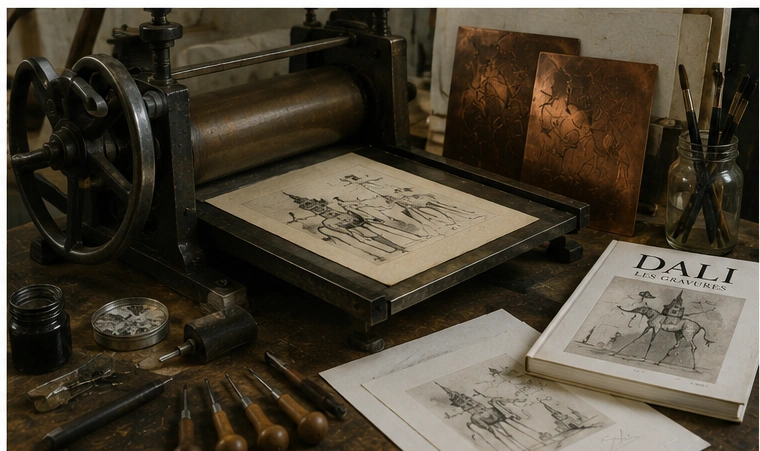
Why Dalí Prints Are Attractive to Collectors
Dalí is one of the most recognizable artists of the twentieth century. His public image — the moustache, the theatrical persona, the dream logic, the combination of classical technique and absurd imagery — is almost inseparable from the market for his work. This creates strong demand at multiple levels.
For collectors, graphic works offer three practical advantages.
First, they are more accessible than paintings. Dalí’s major paintings are rare, institutionally important, and priced at levels far beyond the reach of most collectors. Prints provide a way to enter the artist’s market without competing for museum-level objects.
Second, the graphic market is visually broad. Dalí produced or authorized works connected with literature, religion, mythology, science, eroticism, optical illusion, and historical subjects. A collector can build around a theme: Dante, Don Quixote, biblical imagery, Surrealist figures, mythology, horses, angels, or optical transformations.
Third, the market is active. Dalí graphics appear regularly, which gives collectors the ability to compare works and avoid rushing into the first available example. Availability can be an advantage if the buyer has discipline.
But the same features create risk. A famous name, wide production, repeated imagery, and large circulation make the market attractive to forgers and opportunistic sellers. Dalí is not a field where a collector should rely on surface appearance.
The market rewards informed buying and punishes naïve buying.
The Main Categories of Dalí Graphics
The first step is classification. “Dalí print” is not a precise category.
A serious collector should separate at least six types.
The first category is original etchings, drypoints, lithographs, woodcuts, or mixed-media graphic works created as legitimate limited editions. These are the strongest category when properly documented and referenced.
The second category is portfolio or illustrated-book works, such as sheets connected with literary cycles. These may be collectable, but their value depends on edition, condition, completeness, signature, and whether the sheet has been removed from a book or portfolio.
The third category is hand-signed and numbered editions. Signature and numbering can add value, but only if they belong to an authentic edition. With Dalí, a signature alone is not enough.
The fourth category is works after Dalí. These may be reproductions of known compositions or later prints based on Dalí images. Some can be decorative, but they should not be priced like original graphic works.
The fifth category is posters and offset reproductions. These can be visually attractive but generally occupy a decorative, not investment-grade, category.
The sixth category is problematic or fraudulent material: forged signatures, falsely numbered editions, unauthorized impressions, prints on sheets allegedly signed in advance, and works with weak certificates.
Dalí’s market is particularly difficult because some works sit between categories. For example, Lincoln in Dalivision is often casually called a lithograph, but sources describing the work note that the terminology is more complicated: it is generally treated as a mixed-media object involving photolithography, etched remarque and embossing, and it is also one of the Dalí editions most associated with authentication problems. (wikipedia.org)
For collectors, terminology matters. A seller who cannot explain the medium precisely is already creating risk.
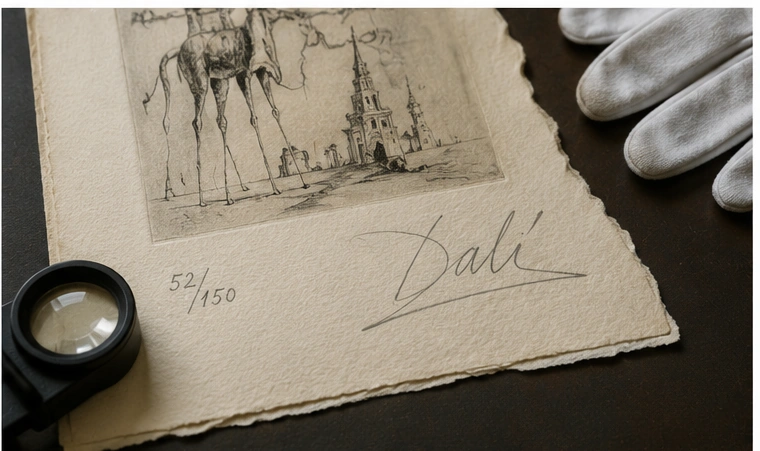
Authentication: The Central Problem
Authentication is the central issue in Dalí graphics.
This is not a marginal concern. It is one of the defining facts of the market. Dalí’s graphic work has long been associated with forgery concerns, especially around signatures and late-edition material. Albert Field, designated by Dalí as his official archivist in 1955, became known for cataloguing and authenticating Dalí works, especially prints; his 1996 Official Catalog of the Graphic Works of Salvador Dalí is widely cited as a core reference for authentic graphic works and known fakes. (wikipedia.org)
The problem remains current. In 2025, Italian art police seized 21 suspected fake works attributed to Dalí from an exhibition in Parma after concerns were raised by the Gala-Salvador Dalí Foundation. The seized works reportedly included engravings, tapestries and drawings; AP noted that the foundation was established by Dalí in 1983 to promote and protect his artistic legacy and flagged irregularities in the works. (apnews.com)
That event matters for collectors because it shows that problematic Dalí works are not just a historical issue from the 1970s. They continue to circulate through exhibitions, dealers, online platforms, and secondary markets.
A serious buyer should therefore request:
catalogue raisonné reference;
edition details;
publisher and printer;
paper type;
signature information;
provenance;
invoice history;
condition report;
certificate source;
high-resolution images;
expert review for higher-value works.
A generic certificate is not enough. Many questionable works come with certificates. The quality of the certificate matters: who issued it, what expertise they have, whether the work is physically examined, and whether the edition is listed in recognized references.
For Dalí, the most dangerous assumption is: “It is signed, therefore it is authentic.”
That is false.
Price Levels: Accessible, But Highly Uneven
Dalí prints are accessible, but the price range is wide and often confusing.
At the lower end, decorative prints, posters, later reproductions, unsigned sheets, and weakly documented works may sell for relatively modest amounts. These can be purchased for visual enjoyment, but they should not be confused with serious collecting assets.
At the middle level, authenticated signed prints from recognized editions can trade in the low thousands to tens of thousands, depending on subject, condition, edition, documentation, and demand.
At the stronger level, rare, well-documented, desirable works from important cycles or with exceptional presentation can command significantly more.
Recent public examples show both accessibility and unpredictability. In 2024, a group of Dalí lithographs discovered after decades in a London garage attracted strong attention; reports before the sale suggested modest estimates for individual signed works, while later reporting described a total result of £19,750 for the group, with one signed limited-edition lithograph reportedly selling for £4,900 and another for £3,100. (nypost.com, thesun.co.uk)
This type of story is useful, but it should not be misread. It does not mean every Dalí lithograph is valuable. It means that fresh-to-market, signed, preserved, and interesting material can still attract buyers.
The broader lesson is more disciplined:
The Dalí graphic market is liquid, but not uniformly strong.
Quality and documentation control price.
Themes Collectors Usually Prefer
Dalí’s strongest graphic subjects are usually those that connect clearly to his recognized visual language.
Collectors often respond to:
Surrealist figures;
melting forms and optical illusions;
horses;
angels;
butterflies;
Dante and literary cycles;
biblical subjects;
mythology;
Don Quixote imagery;
erotic or dreamlike scenes;
scientific and atomic-period imagery;
Gala-related iconography;
classical references transformed through Surrealism.
The most desirable subjects tend to be those that feel unmistakably Dalí. Generic decorative imagery with only a weak connection to his visual universe is less compelling.
However, subject alone is not enough. A desirable subject in a questionable edition is still dangerous. A less famous subject with excellent documentation may be a better acquisition than a dramatic image with weak provenance.
This is especially important because Dalí imagery has been reproduced so widely. The market is full of images that look “Dali-esque.” Looking surreal is not the same as being a strong Dalí graphic work.
The question is not whether the image is attractive. The question is whether the object is defensible.
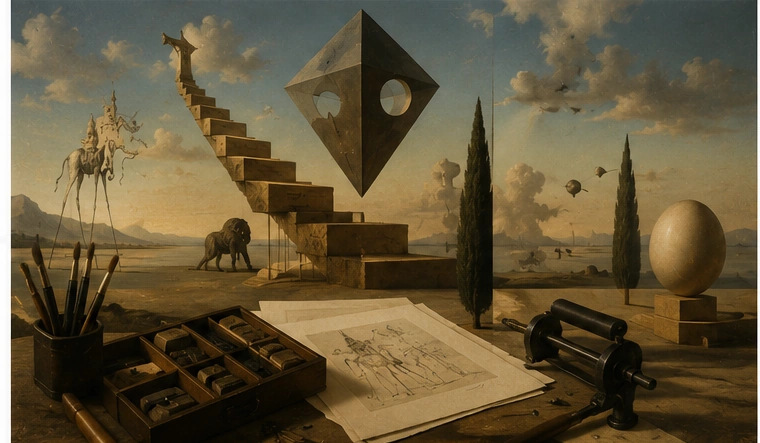
The Role of Literary Cycles
One of the most interesting areas of Dalí graphics is his engagement with literature. Dalí’s printmaking often interacted with canonical texts and stories, including Dante, Cervantes, mythology, and religious narratives.
The Divine Comedy cycle is especially visible. A 2025 Spanish exhibition note described Dalí’s Dante-related woodcuts as connected to an Italian state commission around the 700th anniversary of Dante’s birth; the project generated around one hundred watercolors and required their translation into woodcuts through a complex multi-block printing process. (cadenaser.com)
For collectors, literary cycles can be attractive because they provide structure. A sheet is not only an isolated image; it belongs to a known project. This can help with identification, comparison, and collecting strategy.
But cycles also create challenges. Sheets may be separated from portfolios. Some may be unsigned. Some may exist in different editions. Some may be later restrikes or reproductions. Condition may vary dramatically depending on whether the sheet was kept in a portfolio or framed for decades.
A collector interested in Dalí literary works should ask:
Is this from a recognized cycle?
Is the edition identified?
Was it originally issued as part of a portfolio or book?
Is it complete or separated?
Is it signed?
Is the paper correct?
Is the sheet size consistent with known examples?
Is there a catalogue reference?
Literary cycles can be excellent collecting territory, but only when the edition history is clear.
Condition: Paper Is Fragile
Condition is a major price driver in Dalí graphics.
Many Dalí prints were framed decoratively in the 1960s, 1970s, and 1980s. Poor framing can lead to mat burn, fading, acidic backing, adhesive residue, cockling, foxing, and discoloration. Bright colors can fade. Paper can become brittle. Margins can be trimmed. Signatures can be damaged or obscured.
For works on paper, the margin is part of the object. Edition number, signature, blindstamp, printer’s mark, and paper edge may all matter. A sheet trimmed into the margins may lose value even if the image remains visually intact.
A condition report should include:
sheet size and image size;
margin condition;
paper tone;
foxing;
mat burn;
fading;
creases;
tears;
hinge marks;
water damage;
surface abrasion;
signature condition;
framing history.
For a higher-value Dalí print, inspection outside the frame is important. Many problems are hidden under mats.
The worst case is a work bought as “perfect” because it looked clean behind glass, only to discover fading, acidic damage, or trimmed margins later.
Provenance and Certificates
Provenance is particularly important in Dalí graphics because of the number of problematic works in circulation.
A strong provenance might include:
original gallery invoice;
reputable dealer record;
auction history;
estate documentation;
publisher documentation;
portfolio colophon;
certificate from a recognized expert;
catalogue raisonné reference;
consistent ownership history.
A weak provenance might include:
anonymous online seller;
generic certificate;
no edition details;
unclear publisher;
no paper information;
no catalogue reference;
claims based only on signature;
“from a private collection” without documentation.
The difference is not academic. It affects liquidity. A buyer may accept a questionable Dalí print once, but resale becomes difficult when the next buyer asks for documentation.
For collectors, the aim is not only to buy the work. The aim is to buy the evidence that supports the work.

Collecting Strategy: How to Buy Dalí Graphics Safely
A serious Dalí print strategy should be conservative.
The first rule is to avoid impulse buying. Dalí graphics are widely available. There is rarely a need to rush.
The second rule is to define a category. A collector may focus on Dante woodcuts, Don Quixote imagery, biblical prints, signed etchings, optical works, or a specific period. A defined category makes comparison easier.
The third rule is to prioritize documentation over visual drama. A well-documented, less spectacular sheet may be better than an impressive but poorly documented image.
The fourth rule is to avoid vague descriptions. Terms such as “limited edition,” “signed,” “lithograph,” and “rare” mean little unless supported by details.
The fifth rule is to use specialists. Dalí is not a market for casual authentication.
The sixth rule is to price risk. If documentation is incomplete, the price must reflect that. Do not pay a fully authenticated price for a partially documented work.
A collector should be especially cautious with works that are:
too cheap for the claimed category;
sold with theatrical but vague storytelling;
signed but undocumented;
described as “from the estate” without proof;
accompanied by generic certificates;
offered as rare despite many similar examples online;
framed in a way that prevents inspection.
The more famous the name, the more skepticism is required.
Market Outlook
The outlook for Dalí graphics is best described as active but divided.
Demand for the artist remains strong because Dalí’s brand is global. His imagery continues to attract collectors, decorators, Surrealism enthusiasts, and first-time buyers. This supports liquidity at accessible levels.
However, the market is permanently burdened by authentication risk. That means better-documented works should continue to separate themselves from weak material. The more problematic the overall market becomes, the more valuable reliable documentation becomes.
This is a paradox, but an important one:
The existence of many questionable Dalí prints makes good Dalí prints more dependent on proof.
Collectors should not expect every Dalí print to appreciate. Many will remain decorative. Some will be difficult to resell. Others may become unsellable if doubts arise.
But carefully selected, documented, authentic graphic works can remain attractive, especially when they belong to recognized cycles, have strong imagery, and are in good condition.
Dalí’s graphic market is not a simple investment field. It is a connoisseurship-and-authentication field.
Conclusion: Dalí Prints Reward Skepticism
Collecting Salvador Dalí graphics can be rewarding, but only if approached with discipline.
The appeal is obvious: one of the most famous artists of the twentieth century, a powerful visual language, wide availability, and price levels far below paintings. But the risks are equally obvious: forgeries, weak certificates, confusing edition histories, vague terminology, and a market saturated with questionable material.
The responsible collector does not ask only whether a work looks like Dalí. The responsible collector asks whether the object can survive scrutiny.
What is the exact medium?
Is the edition legitimate?
Is the signature defensible?
Is the work listed in a recognized reference?
Who published it?
What is the condition?
Where has it been?
Can it be resold with confidence?
In the Dalí market, skepticism is not negativity. It is protection.
A good Dalí print can be a powerful acquisition. A bad one can be an expensive lesson. The difference lies in documentation, authentication, and disciplined judgment.
For collectors, the best rule is simple:
Buy the evidence before you buy the image.
Selected Sources
- Albert Field — The Official Catalog of the Graphic Works of Salvador Dalí; Field is widely cited as Dalí’s official archivist and a key figure in Dalí print authentication.
- Associated Press — 2025 seizure of suspected fake Dalí works in Parma after concerns raised by the Gala-Salvador Dalí Foundation.
- Gala-Salvador Dalí Foundation — institutional authority managing and protecting Dalí’s legacy.
- Reports on the 2024 London garage discovery of signed Dalí lithographs and subsequent auction attention.
- Materials on Lincoln in Dalivision and authentication issues around Dalí graphic editions.