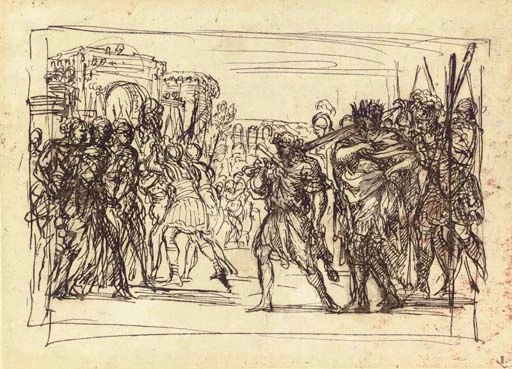

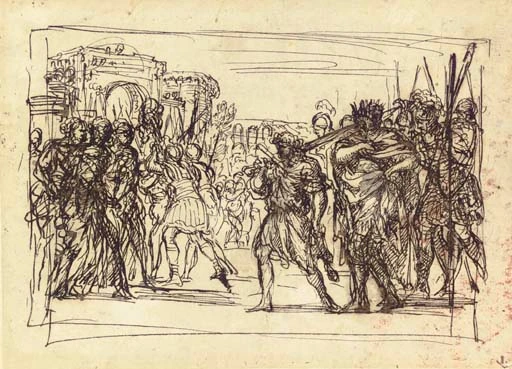
A pen-and-ink drawing by Pietro Berrettini, called Pietro da Cortona, The Triumph of David, was recently acquired on behalf of a private client together with the surviving Christie’s purchase documentation.
The sheet had previously been sold at Christie’s, London, on 3 July 2007, in the Old Master and 19th Century Drawings sale, lot 40. It realised GBP 50,400 against an estimate of GBP 18,000–22,000.
Christie’s catalogued the drawing as an autograph work by Pietro da Cortona. More importantly, the attribution did not depend on auction-house opinion alone. According to the catalogue, Professor Dr Jörg Martin Merz confirmed the attribution after having studied the drawing in the original in 2003. Christie’s further identified it as a preparatory study for Cortona’s lost fresco at the Villa del Pigneto Sacchetti.
The presence of the auction documentation provided a strong starting point for the present examination, but—as with any Old Master drawing—the documents were tested against the physical object itself.
The principal question was whether the surviving sheet was genuinely the same individual drawing illustrated, described and sold by Christie’s.
A second question concerned the material character of the object: whether its paper, ink, execution and internal structure were consistent with an original seventeenth-century drawing rather than a later copy or reproduction.
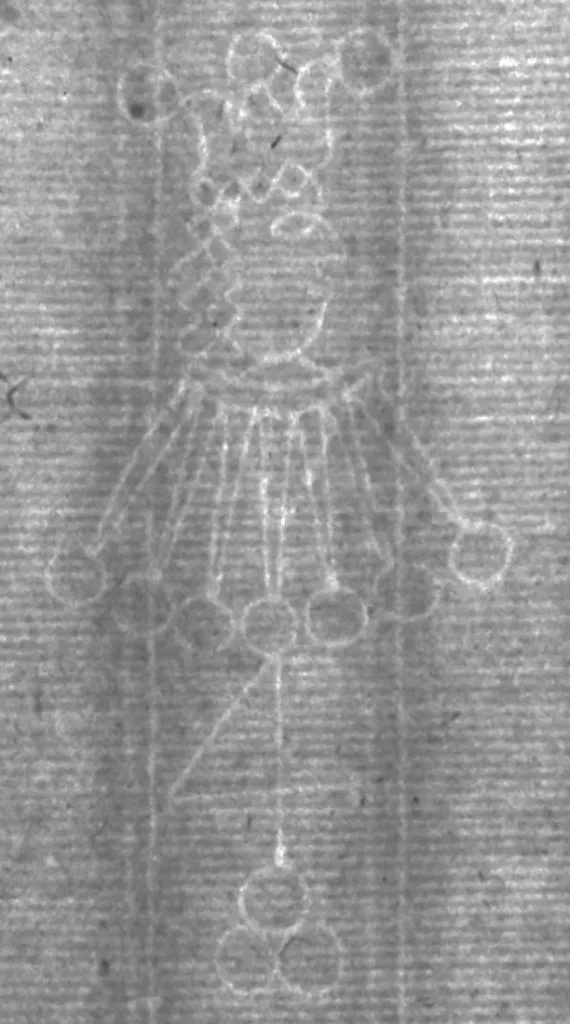
During examination in transmitted light, a substantial additional feature became visible: a Foolscap watermark with a seven-pointed collar. Because several elements of the mark were obscured by the drawing itself, AI-assisted image processing was used to reduce the visual interference caused by the ink and paper texture and reconstruct a clearer image of the watermark.
The resulting evidence provided an additional material point of comparison with seventeenth-century handmade paper.
Pietro Berrettini, called Pietro da Cortona, The Triumph of David. Pen and brown ink, minor losses. 155 × 217 mm. Christie’s, London, 3 July 2007, lot 40.
Pietro da Cortona
Pietro Berrettini, known as Pietro da Cortona, was one of the central figures of Roman Baroque art.
Active as both painter and architect, he developed a monumental pictorial language based on movement, complex groups of figures, spatial illusion and strongly rhetorical gesture. His large decorative cycles—including the celebrated Barberini ceiling in Rome and his work in the Palazzo Pitti in Florence—played a major role in establishing the visual vocabulary of the High Baroque.
Drawing was fundamental to this process.
Cortona’s highly populated compositions could not simply be improvised on the final wall or ceiling. Drawings allowed him to establish the distribution of figures, test movement and gesture and organise complex narratives before execution on a monumental scale.
The Triumph of David belongs directly to this working process.
Identification of the Drawing
The Christie’s record describes the work as:
Pietro Berrettini, called Pietro da Cortona (Cortona 1596–1669 Rome)
The Triumph of David
pen and brown ink, minor losses
155 × 217 mm.
The examined sheet corresponds with these recorded characteristics in dimensions, proportions, composition, medium and individual details of execution.
This correspondence is important because documentary authenticity and object authenticity are separate questions.
An original Christie’s invoice proves that a particular object was sold at Christie’s. It does not automatically prove that a drawing later presented together with those documents is the same object.
For this reason, the sheet was compared directly with the surviving Christie’s record and auction photograph.
The arrangement of the principal figures, architecture, procession, distribution of ink, individual strokes and surviving losses corresponded with the documented work.
No significant discrepancy was found that would suggest the documents had subsequently become associated with another drawing.
Within the scope of the comparative examination, the physical sheet was therefore identified as the same individual drawing sold by Christie’s in 2007.
Christie’s Attribution and Jörg Martin Merz
The attribution has an unusually important documentary element.
Christie’s states that Professor Dr Jörg Merz confirmed the attribution to Cortona in a communication dated 14 May 2007, after having examined the drawing itself in 2003.
This is significant because Merz is one of the principal modern scholars associated with research on Pietro da Cortona and the Villa del Pigneto Sacchetti.
Christie’s further connected the handling of the drawing with Cortona’s studies for the Palazzo Pitti frescoes and cited Merz’s research suggesting a date around 1643 for this phase of the artist’s activity.
The attribution therefore rests on considerably more than stylistic resemblance.
The sheet was studied physically by a specialist, connected to a specific lost composition by Cortona and placed within a particular phase of his draughtsmanship.
The Lost Villa del Pigneto Sacchetti Fresco
Christie’s identified the drawing as a preparatory work for Cortona’s lost fresco in the Villa del Pigneto Sacchetti.
The original fresco no longer survives, making the drawing substantially more important than it would be if the monumental composition remained intact.
The lost painting is known through a copy on canvas preserved in the Quirinal Palace in Rome, cited by Christie’s through Giuliano Briganti’s catalogue of Cortona’s work.
This relationship provides a functional explanation for the drawing.
It is not simply an independent treatment of the biblical Triumph of David. It belongs to the development of a monumental decorative project.
The energetic compression of the procession is characteristic of Cortona’s approach: numerous figures participate simultaneously, but the composition remains organised around a dominant narrative movement.
The drawing records that organisation at the stage when the artist was transforming a complex historical subject into a format suitable for large-scale decoration.
Confirmation of the Physical Original
The examination also considered whether the sheet represented an original hand-executed drawing rather than a printed reproduction or later facsimile.
The pen lines display variations in pressure, density and speed. Individual contours overlap and change direction naturally, while the denser passages consist of accumulated strokes rather than mechanically reproduced areas of tone.
The ink interacts irregularly with the surface of the paper and follows its physical texture.
Most importantly, examination in transmitted light revealed the internal structure of traditional laid paper: closely spaced laid lines, more widely separated chain lines and an integral watermark.
These characteristics are part of the paper itself rather than features applied to its surface.
Taken together with the correspondence with the Christie’s photograph and documentation, the material evidence supports the conclusion that the object is the original hand-executed historical sheet represented in the 2007 auction record.
Recovering the Watermark with AI-Assisted Imaging
The most interesting new result emerged from examination of the paper.
In transmitted light, a large watermark was visible beneath the drawing. The lines of the watermark intersected visually with Cortona’s brown-ink composition, making parts of the design difficult to distinguish directly.
AI-assisted image processing was therefore used to separate the repetitive structural information of the paper and watermark from the darker drawing above it.
This procedure should be understood correctly.
The AI reconstruction was not used to invent missing parts of the watermark or authenticate the drawing. Its role was comparable to other forms of digital image enhancement: to increase the visibility of information already physically present in the sheet.
The processed image revealed the design much more clearly.
It can be identified as a Foolscap with a seven-pointed collar: the stylised head of a court fool above a broad collar terminating in pendant points or bells.
The lower portion of the present mark also appears related to variants incorporating additional geometric elements beneath the collar.
The Foolscap Watermark
The Foolscap—or jester’s head—is one of the better-known families of European paper watermarks.
Numerous variants exist, differing in the shape of the head, number of points on the collar, arrangement of bells and symbols placed beneath the main design. A seven-pointed form is documented on seventeenth-century laid papers. Specialist watermark research records the Foolscap with seven-pointed collar as a distinct morphological group.
Its presence should not, however, be interpreted as a signature of Pietro da Cortona.
Watermarks identify aspects of paper production and circulation, not artistic authorship. A mould used by a papermill could produce many sheets that subsequently travelled through merchants and were purchased by unrelated artists.
This distinction is particularly important because Foolscap papers circulated widely.
Nevertheless, there is a relevant parallel within Cortona’s artistic environment. Christie’s has documented another seventeenth-century drawing catalogued as Circle of Pietro da Cortona, executed in red chalk and pen and brown ink, specifically recording its support as paper with a Foolscap watermark.
This does not prove that the two sheets came from the same mould or workshop. What it demonstrates is more limited but still useful: Foolscap paper is materially compatible with works produced within Cortona’s seventeenth-century artistic milieu.
What the Watermark Actually Proves
The watermark should therefore be treated as supporting material evidence, rather than as the principal argument for attribution.
It demonstrates that the sheet is made on historical laid paper carrying a watermark belonging to a documented European papermaking tradition.
It also provides no obvious chronological contradiction with the proposed seventeenth-century date.
What it does not demonstrate is equally important.
A Foolscap watermark cannot establish that Cortona personally drew the composition, cannot identify the place where the drawing was executed and cannot date the sheet to a single year.
Nor can the present image alone establish that two visually similar Foolscap marks derive from the same papermaking mould.
That would require measurement of the watermark at actual scale, comparison of its exact contours, the spacing of chain lines and laid lines, and ideally superimposition with securely dated reference examples.
The evidential value of the watermark is therefore material and chronological rather than attributional.
An Unusually Strong Evidential Structure
What makes the present drawing particularly interesting is not any single feature, but the convergence of several independent forms of evidence.
The physical sheet corresponds to the Christie’s auction image and recorded dimensions.
The Christie’s purchase documentation has been preserved with the work.
The drawing was catalogued by Christie’s as Pietro da Cortona and sold publicly under that attribution.
Professor Jörg Martin Merz had examined the original and independently confirmed the attribution before the 2007 sale.
The composition was identified as preparatory for Cortona’s lost fresco in the Villa del Pigneto Sacchetti.
Its handling was related by Merz to drawings associated with the Palazzo Pitti period.
The sheet itself is an original hand-executed work on historical laid paper.
Finally, transmitted-light examination revealed a Foolscap watermark whose typology is compatible with seventeenth-century European paper.
These elements are much stronger collectively than any of them would be independently.
Market History
The public auction history provides another useful reference point.
Christie’s offered The Triumph of David in London on 3 July 2007, with an estimate of GBP 18,000–22,000.
The drawing realised GBP 50,400, more than twice the upper estimate.
The result is understandable given the characteristics of the sheet.
It is an autograph drawing attributed to one of the central masters of Roman Baroque painting; its connection with a specific monumental commission is documented; the original fresco is lost; and the attribution had been supported before the sale by a leading Cortona scholar.
The recent acquisition for a private client therefore represents more than the purchase of an attractive Old Master drawing. It concerns an object with a documented auction identity and a defined place within Cortona’s artistic production.
Conclusion
Pietro da Cortona’s The Triumph of David was recently examined following its acquisition on behalf of a private client.
The complete surviving Christie’s documentation was compared with the physical object rather than accepted as sufficient evidence by itself.
The dimensions, proportions, composition, medium, individual drawing characteristics and areas of loss correspond with the work illustrated and described by Christie’s in 2007.
The auction record provides an additional and unusually important attributional history: Professor Dr Jörg Martin Merz had studied the drawing in the original and confirmed its attribution to Pietro da Cortona. Christie’s identified the sheet as preparatory for the artist’s lost fresco in the Villa del Pigneto Sacchetti and related its handling to Cortona’s drawings associated with the Palazzo Pitti period.
Material examination produced a further finding.
Using transmitted-light photography followed by AI-assisted image processing, it was possible to isolate a previously difficult-to-read watermark beneath the ink composition. The design corresponds to the Foolscap with seven-pointed collar family.
The watermark does not independently establish Cortona’s authorship, and it should not be presented as doing so. Its importance is more precise: it forms part of the physical history of the sheet and is compatible with seventeenth-century handmade European paper.
The final assessment therefore rests on the agreement of the entire evidential structure rather than on a single clue.
Within the scope of the documentary, comparative and material examination, the sheet was confirmed as the same original hand-executed drawing sold by Christie’s in 2007, with its documented attribution to Pietro da Cortona and its connection to the lost Villa del Pigneto Sacchetti fresco intact.
Its particular significance lies in the combination of a major Baroque author, a lost monumental composition, documented specialist attribution, preserved Christie’s history and newly recoverable material evidence contained within the paper itself.