
Category: Value & Pricing
Estimated reading time: 7–8 min
Art pricing is one of the most complex areas of the art market because it brings together two systems that do not naturally speak the same language: cultural value and financial value.
A work of art may be emotionally powerful, visually refined, historically important, technically sophisticated, and still difficult to price. Another work may seem visually modest but command a high value because of provenance, rarity, institutional recognition, market scarcity, or the artist’s position within a broader cultural narrative.
This is why price in the art market should never be understood as a simple reflection of beauty, size, material, or effort. Art prices are constructed through a layered system of signals. Some are visible: auction results, gallery prices, artist reputation, and comparable sales. Others are less visible: collector demand, supply control, market confidence, institutional validation, and the strategic behavior of galleries, advisors, and sellers.
For collectors, the most dangerous mistake is to ask only: How much does it cost?
The more serious question is: Why does it cost this much — and is the price defensible?
This is the central task of value and pricing analysis.

Price and Value Are Not the Same Thing
In everyday language, price and value are often used interchangeably. In the art market, they must be separated.
Price is the amount requested or paid in a transaction.
Value is the broader justification for that amount.
A price may be high without being well supported. A work may be offered aggressively because the seller expects momentum, because the artist is fashionable, or because the gallery wants to establish a new price level. But a high asking price does not necessarily mean that the market would accept the same level in a resale context.
Conversely, a work may be undervalued if it belongs to an artist whose institutional relevance is growing but whose market has not yet fully adjusted. In such cases, the price may not reflect the future strength of the artist’s position.
This distinction is essential. A collector who buys only by price risks confusing cost with significance. A collector who buys only by personal attraction risks ignoring liquidity, market hierarchy, and long-term positioning.
The strongest acquisitions usually sit at the intersection of several factors:
the work is aesthetically strong;
the price is supported by comparable evidence;
the artist’s position is credible;
the specific work is representative or important;
the market has depth;
the provenance and condition are clear.
In other words, valuation is not about finding a single number. It is about building an argument.
A defensible price is one that can be explained.
Comparable Sales: Useful, but Never Sufficient
Comparable sales are one of the standard tools in art valuation. They help establish a price range by looking at similar works by the same artist or closely related artists. In auction analysis, comparables are often used to justify estimates. In private sales, they help structure negotiation.
However, comparable sales are frequently misused.
The problem is that no two artworks are truly identical. Even works by the same artist can vary dramatically in value depending on period, medium, scale, subject, quality, condition, provenance, exhibition history, and rarity. A collector cannot simply look at the last sale by an artist and assume that the same price logic applies.
For example, a large canvas from an artist’s most recognized period cannot be compared directly with a small work on paper from a less central phase. A work exhibited in a museum survey cannot be treated the same as an unexhibited studio piece. A painting from a signature series may carry much stronger market weight than a technically similar but less identifiable work.
This is why serious pricing analysis requires a hierarchy of comparability.
The strongest comparable is a work that matches closely in artist, medium, period, scale, subject, quality, provenance, and market context. The weaker the match, the more cautious the valuation must become.
Comparable sales should therefore be treated as evidence, not as proof. They provide a framework, but they do not replace judgment.
The question is not simply: What did another work sell for?
The better question is: How comparable was that work, and under what conditions did it sell?
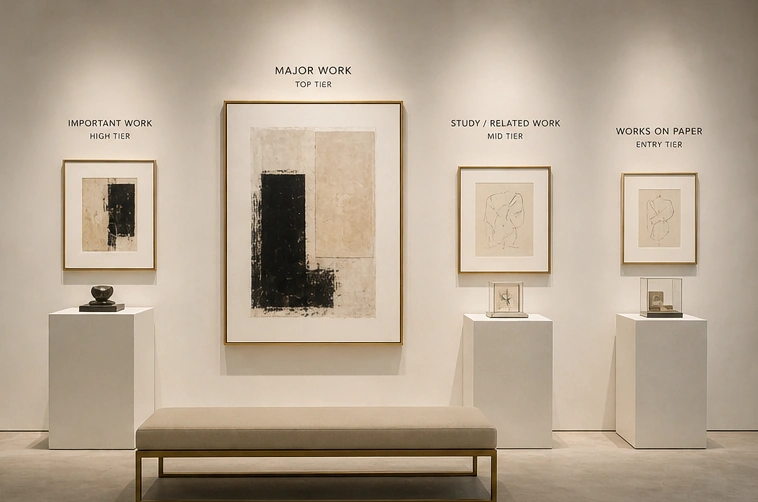
The Artist’s Market Hierarchy
Every artist’s market has an internal hierarchy. Understanding that hierarchy is one of the most important parts of valuation.
At the top are usually the works that best represent the artist’s strongest contribution. These may be works from a mature period, a breakthrough series, a historically significant body of work, or a medium for which the artist is especially recognized. These works tend to attract the deepest demand and the strongest pricing.
Below that are works that are still desirable but less central: smaller works, studies, works on paper, editions, early experiments, late minor works, or pieces outside the artist’s most recognized language.
This hierarchy does not mean that only top-tier works are worth collecting. Smaller or more accessible works can be excellent acquisitions if they are priced correctly and hold a meaningful place within the artist’s practice. But they should not be valued as if they belonged to the top of the market.
Many pricing mistakes occur when sellers use the artist’s highest results to justify prices for weaker works. This is a common distortion. A record auction result for a major painting does not automatically raise the value of every drawing, print, or minor work by the same artist.
For collectors, this means that the artist’s name is only the starting point. The real valuation question is:
Where does this specific work sit within the artist’s total production?
A strong advisor should be able to explain that position clearly. If the answer is vague, the pricing is probably weakly supported.
Primary Market and Secondary Market Pricing
The primary market and secondary market operate according to different pricing logics.
The primary market refers to the first sale of a work, usually through the artist’s gallery or studio. Pricing in the primary market is often managed carefully. Galleries typically want to protect gradual price development, avoid speculation, and place works with collectors who support the artist’s long-term career.
The secondary market refers to resale: auctions, private sales, dealers, and collectors selling previously acquired works. Here, price is shaped more directly by public demand, scarcity, liquidity, and previous transaction history.
A healthy artist market usually requires balance between the two. If primary prices rise too quickly, the secondary market may not support them. If secondary prices dramatically exceed primary prices, speculation may increase and galleries may lose control of placement. If works return too quickly to auction, confidence may weaken.
For emerging and mid-career artists, this balance is especially delicate. A young artist may have strong gallery demand but limited secondary-market evidence. In such cases, pricing depends heavily on gallery credibility, collector waiting lists, institutional attention, and scarcity management.
For established artists, secondary-market evidence becomes more important. Auction results, dealer transactions, and private-sale comparables help define price levels more clearly.
Collectors should understand which market they are entering. Buying from a primary gallery may offer access to an artist’s developing practice, but resale may not be immediate. Buying at auction may offer transparency, but also competition, buyer’s premium, and public price history. Buying privately may offer discretion, but requires stronger due diligence.
Each pricing environment carries its own advantages and risks.
The Role of Provenance, Condition, and Documentation
Provenance, condition, and documentation are not administrative details. They are pricing factors.
Provenance refers to the history of ownership. A work with clear, reputable provenance is easier to evaluate and usually more attractive to serious collectors. If a work has passed through respected galleries, notable collections, or institutional exhibitions, its market position may be stronger.
Weak or unclear provenance creates uncertainty. In some cases, it may raise legal, authenticity, or reputational questions. Even if the work is visually strong, poor documentation can reduce confidence and price.
Condition also directly affects value. Damage, restoration, fading, structural instability, or conservation concerns can materially change pricing. This is especially relevant for works on paper, photography, sculpture, installation, and older paintings. A work in compromised condition may still be important, but the price should reflect the risk.
Documentation includes certificates, invoices, gallery letters, exhibition records, catalogue references, condition reports, and authenticity materials. Documentation does not automatically make a work valuable, but it helps make value defensible.
For collectors, these factors are critical because they affect both acquisition and future resale. A work that is difficult to document today may become even more difficult to sell tomorrow.
In serious collecting, paperwork is not secondary to the artwork. It is part of the asset structure.
Scarcity and Supply Control
Scarcity can strengthen pricing, but only when demand exists.
A rare work by an artist with no meaningful collector base may remain illiquid. A widely produced artist may still have high value if the best works are scarce and well held. Therefore, scarcity must always be evaluated together with demand, quality, and market depth.
There are different forms of scarcity.
One is production scarcity: the artist made very few works.
Another is market scarcity: important works exist but rarely appear for sale.
Another is quality scarcity: many works exist, but few are truly strong.
Another is period scarcity: works from a specific phase are limited and highly desired.
The strongest scarcity is usually market scarcity combined with quality scarcity. This means that excellent works exist, but serious collectors hold them tightly, and few come to market.
Supply control is especially important in the primary market. Galleries often manage how many works are released, where they are placed, and how quickly prices rise. If supply is released too aggressively, the market may become saturated. If too little is available, demand may build, but access may become difficult.
In secondary markets, scarcity often becomes visible through auction frequency. If major works rarely appear, a strong example can generate competition. But if too many works appear in a short period, buyers may become cautious.
For pricing analysis, the question is not only how many works exist. The question is how many meaningful works are available at this level of quality.

Why Asking Prices Can Be Misleading
One of the most common errors in art buying is treating asking prices as market prices.
An asking price reflects what the seller wants. It does not always reflect what the market will pay. In opaque private markets, asking prices can be aspirational, strategic, or inflated. They may be designed to create a perception of strength, anchor negotiation, or support a new pricing level.
This is why buyers should distinguish between:
asking price;
achieved price;
hammer price;
price with premium;
private-sale price;
gallery retail price;
net seller result.
These numbers are not the same.
At auction, public results are visible, but even they require interpretation. A hammer price below estimate may indicate weak demand. A result above estimate may indicate competition. But guarantees, irrevocable bids, buyer’s premium, and currency effects can complicate the reading.
In private sales, the real achieved price may never become public. A work listed at one price may sell after negotiation at another. A gallery may quote different levels depending on client relationship, availability, and placement strategy.
For collectors, the practical rule is simple: never evaluate price without context.
A price becomes meaningful only when it can be connected to evidence.
Value Is Also Built Through Time
The strongest art markets are rarely built overnight. They develop through time: exhibitions, publications, collections, institutional interest, critical writing, and repeated market validation.
This temporal dimension matters because premature pricing can be dangerous. When an artist’s prices rise faster than their institutional or collector base, the market may become fragile. If early buyers attempt to resell quickly and demand is not deep enough, prices can fall.
A more sustainable market develops gradually. Prices rise in relation to stronger demand, better placements, more significant exhibitions, and increasing scarcity of important works.
For collectors, this means patience can be a strategic advantage. Buying before the market fully recognizes an artist can produce value, but only if the artist’s position is genuinely developing. Buying after the market has already moved can still be justified, but only if the work is strong enough and the price remains defensible.
Timing is therefore not only a financial question. It is an interpretive question.
The collector must ask:
Is the artist’s market early, mature, overheated, or correcting?
Is the current price supported by the artist’s development?
Is demand likely to broaden or narrow?
Is the work strong enough to remain desirable across cycles?
Price is a moment. Value is a trajectory.
The Advisor’s Role in Pricing
The role of an art advisor is not simply to say whether a work is expensive or cheap. The role is to analyze whether the price is justified.
That requires several layers of assessment:
artistic quality;
market comparables;
artist positioning;
provenance;
condition;
supply;
collector demand;
liquidity;
negotiation context;
long-term relevance.
A serious pricing recommendation should be able to explain not only what the work may be worth, but also where the uncertainties are. In some cases, the correct conclusion is not a fixed number, but a range. In others, the conclusion may be that the work is attractive but overpriced, or fairly priced but weak in resale potential, or undervalued but carrying documentation risk.
Good advisory work does not remove uncertainty completely. No one can predict the art market with precision. But it can reduce avoidable error.
The art market rewards informed judgment. It punishes emotional overpayment, weak due diligence, and superficial comparison.

Conclusion: A Defensible Price Is an Argument
Art pricing is never only a number. It is an argument built from evidence.
A defensible price must explain the artist’s position, the quality of the work, the relevance of the period, the strength of provenance, the condition, the availability of comparable works, the depth of demand, and the logic of the transaction.
This is why two visually similar works can have very different values. One may belong to a major period, carry strong provenance, and be supported by institutional recognition. Another may be decorative, undocumented, and weakly positioned within the artist’s practice. The surface may look similar. The market logic is not.
For collectors, value and pricing analysis provides discipline. It does not replace taste, but it prevents taste from becoming financially careless. It does not eliminate emotion, but it places emotion within a structure of evidence.
The most intelligent collectors understand that a good acquisition is not simply a work they like. It is a work they can defend: aesthetically, historically, and financially.
In the art market, price is visible. Value is constructed.
Understanding the difference is the foundation of serious collecting.